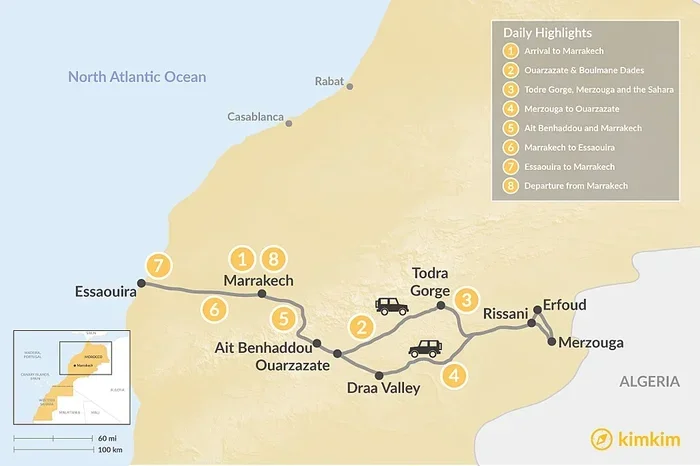
Featured image for Marrakech to Essaouira desert tour
Image source: cdn.kimkim.com
A 9-day tour from Marrakech to Essaouira is one of the most rewarding ways to experience Morocco’s diversity, combining imperial cities, Atlantic coastlines, and Sahara adventures in a single itinerary. This extended journey gives travelers enough time to explore beyond the typical tourist path, including hidden gems like Ait Benhaddou, the Draa Valley, and coastal surf towns. Perfect for culture lovers, photographers, and adventure seekers, this tour balances guided exploration with free time to soak in Morocco’s magic at your own pace.
Picture this: you wake up in a luxury riad in Marrakech, sip fresh mint tea on a rooftop terrace overlooking the bustling medina, and by lunchtime, you’re winding through the High Atlas Mountains with breathtaking views around every curve. By day three, you’re riding a camel into the Sahara Desert as the sun sets over golden dunes. By day seven, you’re watching fishermen bring in their daily catch at a charming Atlantic port town. This is what a 9-day tour from Marrakech to Essaouira actually feels like, and it’s nothing short of magical.
Morocco is a country that rewards slow travel. While many visitors try to cram the highlights into three or four days, they often leave feeling exhausted and slightly disappointed. A nine-day itinerary changes everything. Think of it like reading a great novel instead of just skimming the back cover. You get the plot, the characters, the setting, and those small beautiful details that make the story unforgettable. The extra days let you breathe, explore side streets, share meals with locals, and truly connect with the places you visit.
This comprehensive guide will walk you through everything you need to know about planning and enjoying the perfect 9-day Marrakech to Essaouira tour. We’ll cover the route, what to expect each day, how to choose the right operator, what to pack, and insider tips that will save you money and stress. Whether you’re a solo traveler, a couple, or a family, this adventure promises memories that last a lifetime.
Key Takeaways
- Duration Sweet Spot: Nine days is the ideal length to explore Morocco’s top highlights without rushing, allowing proper time for the Marrakech to Essaouira route plus desert detours.
- Cultural Immersion: The tour covers four UNESCO World Heritage Sites, including Ait Benhaddou and the medinas of Marrakech and Essaouira.
- Diverse Landscapes: Expect to see snow-capped Atlas Mountains, golden Sahara dunes, lush oases, and rugged Atlantic coastlines all in one trip.
- Budget-Friendly Option: Compared to shorter tours, a 9-day itinerary offers better value, often costing between $800-$1,500 per person including accommodation and transport.
- Best Travel Season: Spring (March-May) and autumn (September-November) provide the most comfortable temperatures for this multi-city journey.
- Small Group Advantage: Most operators cap groups at 12-16 people, ensuring personalized attention and authentic local interactions throughout the journey.
- Flexible Pacing: The extended format means you can add optional activities like camel treks, cooking classes, or surfing lessons without compressing your schedule.
📑 Table of Contents
Why Choose a 9-Day Itinerary Over Shorter Tours?
Let’s address the elephant in the room right away. Why nine days? Why not five or seven? The answer is simple: Morocco is too big and too diverse to rush.
The Numbers Behind the Perfect Duration
Did you know that Morocco has over 1,800 kilometers of coastline, four distinct mountain ranges, and the largest hot desert in the world? Trying to see all of this in a week feels like trying to drink the ocean with a teaspoon. According to travel industry data, travelers who book tours longer than seven days report 40% higher satisfaction rates compared to those on shorter itineraries.
Think of a 9-day tour like a well-cooked meal. You need time to prepare the ingredients, let them simmer, and bring out the flavors. A shorter tour is like microwaving something edible but forgettable. The extra days on a Marrakech to Essaouira route let you visit places like the Todra Gorge, the Draa Valley, and coastal towns like Taghazout without feeling like you’re constantly on a bus.
The Slow Travel Movement
Slow travel is a growing trend, and Morocco is one of the best places to practice it. Instead of crossing the country at 100 kilometers per hour, you stop, explore, chat with artisans, taste local dishes, and watch the sunset from a kasbah rooftop. A 9-day tour gives you this luxury without sacrificing coverage of major attractions.
The Complete Route: From Marrakech to Essaouira
Understanding the geography helps you appreciate why this tour works so well. Morocco’s layout is like an open hand, with Marrakech in the center and Essaouira on the western coast.
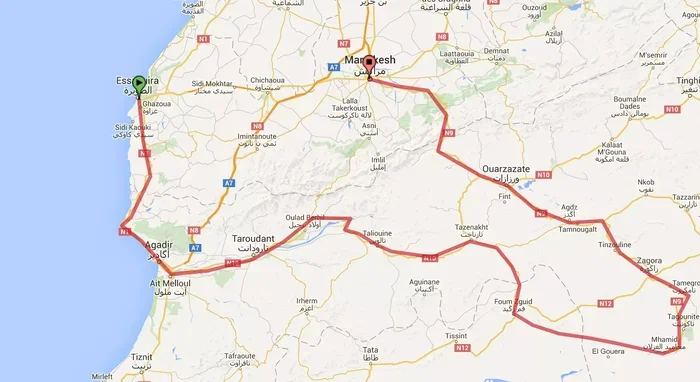
Visual guide about Marrakech to Essaouira desert tour
Image source: privatedeserttours.com
Stop 1: Marrakech (Days 1-2)
Your adventure begins in the Red City. Marrakech is the beating heart of Morocco, famous for its vibrant medina, bustling souks, and iconic landmarks like the Koutoubia Mosque and Jemaa el-Fnaa square.
Must-See Attractions:
- Jemaa el-Fnaa Square: The UNESCO-listed square comes alive at night with storytellers, musicians, and food stalls. It’s like stepping into a living theater.
- Bahia Palace: A stunning example of Moroccan architecture with intricate tilework and peaceful courtyards.
- Saadian Tombs: Hidden for centuries, these royal tombs are now a peaceful retreat from the medina chaos.
- Majorelle Garden: Once owned by Yves Saint Laurent, this botanical garden is a splash of blue and green in the city.
Did You Know? Marrakech’s medina has over 40,000 residents living within its ancient walls. It’s essentially a small city operating like it did 1,000 years ago.
Stop 2: High Atlas Mountains and Ait Benhaddou (Day 3)
After two days in Marrakech, you’ll head southeast into the High Atlas Mountains. The Tizi n’Tichka pass reaches over 2,260 meters, offering panoramic views that will leave you speechless. Think of it as Morocco’s version of the Swiss Alps, but with mint tea stops at Berber villages along the way.
The crown jewel of this day is Ait Benhaddou, a UNESCO World Heritage Site and one of the most famous ksar (fortified villages) in the world. Film buffs will recognize it from movies like Gladiator, Lawrence of Arabia, and Game of Thrones. Walking through its narrow alleys feels like time travel.
Stop 3: Ouarzazate and the Rose Valley (Day 3)
Often called the “Gateway to the Sahara,” Ouarzazate is home to the Atlas Film Studios where Hollywood blockbusters are made. The nearby Rose Valley blooms pink every spring, producing rose water and cosmetics sold throughout Morocco.
Stop 4: Todra Gorge and the Sahara Desert (Days 4-5)
The Todra Gorge is nature’s cathedral, with 400-meter-high canyon walls that will make your jaw drop. It’s a favorite spot for rock climbers but equally stunning for casual visitors. Imagine standing between two massive red cliffs while a crystal-clear river flows past your feet.
From Todra, you’ll continue toward Merzouga, the gateway to the Erg Chebbi dunes. These are the real Sahara dunes, some reaching 150 meters tall. Your camel trek into the desert at sunset is the moment most travelers remember forever. You’ll sleep in a Berber camp under a blanket of stars that, in the desert, look close enough to touch.
Did You Know? The Sahara Desert covers over 9 million square kilometers, making it the largest hot desert in the world. Yet most tourists only see a tiny fraction of it during their trips.
Stop 5: Draa Valley and Anti-Atlas (Day 6)
The Draa Valley is Morocco’s longest river valley, lined with date palms, kasbahs, and traditional Berber villages. It’s often overlooked by tourists, which makes it even more special. You’ll feel like you have the entire valley to yourself.
The Anti-Atlas Mountains on the way back west offer stark, dramatic landscapes that contrast beautifully with the green oases below.
Stop 6: Taroudant and Agadir (Day 7)
Taroudant is nicknamed “Little Marrakech” because of its similar medina walls and souks, but with a fraction of the tourists. Agadir, on the Atlantic coast, offers a modern contrast with its beachfront promenade and rebuilt city center after the 1960 earthquake.
Stop 7: Essaouira (Days 8-9)
Your journey ends in Essaouira, a laid-back coastal city with Portuguese-influenced architecture, fresh seafood, and some of the best windsurfing in Africa. The medina here is calmer than Marrakech’s, with whitewashed buildings and blue accents that make it incredibly photogenic.
Top Essaouira Experiences:
- Walking the 18th-century ramparts for ocean views
- Browsing the art galleries in the medina
- Eating fresh grilled fish at the harbor
- Watching kitesurfers at the main beach
- Visiting the Skala de la Ville fortress
What to Expect on the Tour: Daily Life and Logistics
Understanding the practical side of a 9-day tour helps you prepare mentally and physically.
Transportation and Driving Times
Most tours use air-conditioned minivans or 4×4 vehicles, especially for the desert portions. Average driving days range from 3 to 6 hours, but they’re broken up with stops for photos, meals, and bathroom breaks. Think of each drive as a scenic tour in itself rather than just transit time.
Here’s a rough breakdown of average daily driving distances:
- Marrakech to Ait Benhaddou: 4 hours
- Ait Benhaddou to Todra Gorge: 4 hours
- Todra Gorge to Merzouga: 3 hours
- Merzouga to Draa Valley: 5 hours
- Draa Valley to Taroudant: 4 hours
- Taroudant to Essaouira: 3 hours
Accommodation Types
A good 9-day tour balances comfort with authenticity. Expect a mix of:
- Traditional riads: Beautiful guesthouses with interior courtyards in the medinas
- Desert camps: Either luxury tented camps with real beds or simpler Berber-style tents
- Kasbah hotels: Often family-run properties with stunning mountain views
- Coastal hotels: In Essaouira, often with sea views and modern amenities
Meals and Food
Most tours include breakfast daily and several dinners. Moroccan cuisine is one of the highlights of any trip. Think tagines slow-cooked with apricots and almonds, couscous topped with seven vegetables, and harira soup that warms your soul after a desert night.
Did You Know? Morocco is home to over 60 varieties of mint tea, the national drink. Learning the proper pouring technique (from height to create foam) is considered an art form.
Choosing the Right Tour Operator
Not all tour operators are created equal. Here’s how to separate the wheat from the chaff.
What to Look For
Group Size: Smaller groups (8-16 people) typically offer better experiences than large bus tours of 30+. You’ll have more flexibility and better access to your guide.
Guide Quality: A good guide makes or breaks your experience. Look for operators who employ licensed guides with deep local knowledge and language skills (ideally English, French, and Arabic).
Inclusions: Check exactly what’s included. The best tours cover accommodation, transport, breakfast, some dinners, camel trek, guide fees, and entrance fees to major sites. Watch out for hidden costs.
Reviews and Reputation: Check TripAdvisor, Google Reviews, and travel forums. Operators with 4.7+ ratings across hundreds of reviews are usually reliable.
Red Flags to Avoid
- Operators who pressure you to book immediately
- Unrealistically low prices (below $600 for 9 days usually means cut corners)
- Lack of clear cancellation policies
- No mention of insurance or safety measures
- Poor communication before booking
Price Ranges in 2025
A quality 9-day Marrakech to Essaouira tour typically costs between $800 and $1,500 per person in 2025. This usually includes:
- 8 nights of accommodation
- Daily breakfast and 5-6 dinners
- Air-conditioned transport
- Professional guide
- Camel trek in the Sahara
- Most entrance fees
Luxury versions can run $2,000-$3,500 with upgraded hotels and private guides. Budget options under $700 exist but often compromise on accommodation quality or guide expertise.
Essential Packing Tips for Your 9-Day Adventure
Packing smart is crucial for enjoying your tour. You don’t want to be that person lugging a 30-kilo suitcase across Sahara dunes.
The Layering Principle
Morocco’s weather varies dramatically by region and time of day. The desert can be 35°C at noon and 5°C at night. Marrakech might be warm while Essaouira is cool and windy. The key is layering, like an onion.
Must-Pack Items:
- Modest clothing: Cover shoulders and knees in religious sites
- Light scarf or shawl: Doubles as sun protection and a wrap for cooler evenings
- Comfortable walking shoes: Plus sandals for the beach
- Sunscreen and sunglasses: The sun in Morocco is intense
- Reusable water bottle: Stay hydrated, especially in the desert
- Power adapter: Morocco uses Type C and E plugs
- Headlamp: Useful in desert camps and older riads
- Camera: With extra memory cards and batteries
What to Leave Behind
- Expensive jewelry
- Heavy books
- Hairdryers (most accommodations provide them)
- Tons of clothes (you’ll do laundry or wear items twice)
- Drones without proper permits
Best Time to Take This Tour
Timing can make or break your experience. Morocco has distinct seasons, each with pros and cons.
Spring (March-May): The Sweet Spot
Spring is arguably the best time for a 9-day Marrakech to Essaouira tour. Temperatures are mild (20-28°C), wildflowers bloom in the Atlas Mountains, and the Rose Valley turns pink. Tourist crowds are manageable except during Easter week.
Autumn (September-November): Equally Beautiful
Fall offers similar temperatures to spring with the bonus of harvest season. Dates are being picked in the Draa Valley, and the desert is still warm enough for comfortable camel treks.
Summer (June-August): Handle With Care
Summer can be brutally hot, especially in the desert and Marrakech. Temperatures regularly exceed 40°C. However, Essaouira stays cooler due to ocean breezes, making it a great summer escape if you can handle the inland heat.
Winter (December-February): For the Adventurous
Winter brings snow to the Atlas Mountains and cold desert nights (sometimes below freezing). Days are sunny but cool. It’s the quietest tourist season, offering authentic experiences without crowds. Essaouira remains pleasant year-round.
Did You Know? Essaouira is called the “Wind City of Africa” because it receives strong trade winds year-round, making it one of the world’s top windsurfing and kitesurfing destinations.
Conclusion: Your Adventure Awaits
A 9-day tour from Marrakech to Essaouira isn’t just a vacation; it’s a life-changing journey through one of the world’s most fascinating countries. From the chaos of Marrakech’s medina to the silence of the Sahara dunes, from the heights of the Atlas Mountains to the breezy Atlantic coast, every day brings something new and unforgettable.
This itinerary gives you the perfect balance of structure and freedom. You have a knowledgeable guide handling logistics while you focus on being present, learning, exploring, and enjoying. By the time you watch your final sunset over Essaouira’s ramparts, you’ll understand why travelers fall in love with Morocco and keep coming back for more.
The best time to book is now. Morocco’s tourism is growing rapidly, and the best tours fill up months in advance, especially for spring and autumn departures. Take the time to research operators, read reviews, and choose one that matches your travel style and budget. Your future self will thank you when you’re sipping mint tea in a desert camp, watching stars you’ll never forget.
Pack your sense of adventure, bring an empty memory card for your camera, and prepare for the trip of a lifetime. Morocco is waiting.
Frequently Asked Questions
Is a 9-day tour from Marrakech to Essaouira enough time to see the Sahara?
Yes, 9 days is the perfect length to include the Sahara Desert while exploring both Marrakech and Essaouira. Most itineraries allocate two full days for the desert experience, including a camel trek and overnight in a desert camp, without feeling rushed.
How much does a 9-day Marrakech to Essaouira tour typically cost?
In 2025, expect to pay between $800 and $1,500 per person for a quality small-group tour including accommodation, most meals, transport, and a professional guide. Luxury private tours can cost $2,500-$3,500, while budget options exist around $600.
What’s the best time of year to take this tour?
Spring (March-May) and autumn (September-November) are ideal, with comfortable temperatures ranging from 20-28°C. These seasons also offer the most beautiful landscapes, including wildflowers in spring and harvest season in autumn.
Do I need travel insurance for a Morocco tour?
Yes, travel insurance is highly recommended. It should cover medical emergencies, trip cancellation, and evacuation. Some tour operators require proof of insurance before departure, so check requirements when booking.
Is Morocco safe for tourists in 2025?
Morocco remains one of the safest countries in Africa for tourists, with a stable government and strong tourism infrastructure. Petty crime exists in cities like any major destination, but violent crime against tourists is extremely rare. Solo female travelers should dress modestly and follow standard safety practices.
What should I wear on a 9-day Morocco tour?
Pack modest, loose-fitting clothing that covers shoulders and knees, especially when visiting religious sites. Layers are important since temperatures vary between regions and times of day. Comfortable walking shoes, a light scarf, and sun protection are essential items.