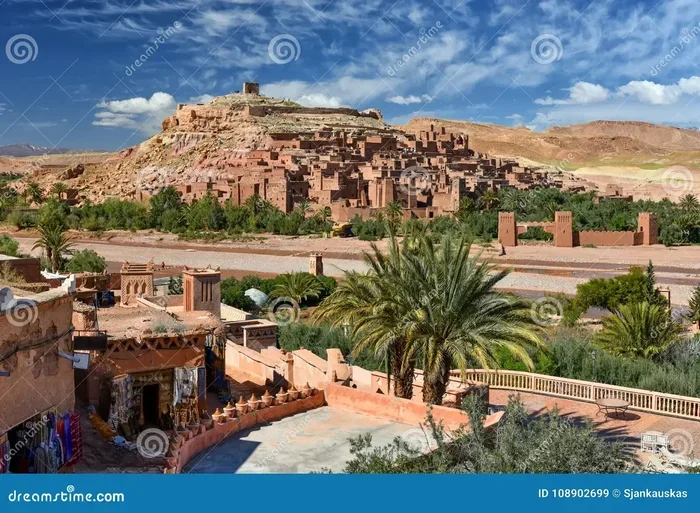
Featured image for Ait Ben Haddou Kasbah Morocco
Image source: thumbs.dreamstime.com
An 8 day tour from Tangier to Ait Ben Haddou takes you through Morocco’s most legendary landscapes in just over a week. Starting from the Mediterranean coast, this journey winds through Chefchaouen’s blue streets, Fes’s ancient medina, the Sahara’s golden dunes, and finally to the UNESCO-listed Ait Ben Haddou. It’s the perfect route for travelers who want to see Morocco’s full spectrum, from mountain villages to desert oases, without rushing.
Picture this: you wake up one morning in Tangier, a bustling port city where the Mediterranean kisses the Atlantic. By the end of your trip, you’ll be standing beside a 17th-century mud-brick fortress that has survived earthquakes, starred in Hollywood films, and still shelters families within its ancient walls. That’s the magic of an 8 day tour from Tangier to Ait Ben Haddou.
This route is one of Morocco’s grand circuits. It stitches together the country’s most photogenic spots like beads on a string. You don’t just see Morocco, you feel it shift beneath your feet. The air changes from salty sea breeze to pine-scented mountain chill to dry desert heat. The languages shift from Spanish-influenced Arabic to Berber. Even the bread changes shape.
What makes this particular journey special is the pacing. Eight days gives you room to breathe. You can linger in a mosaic workshop in Fes, share mint tea with a desert nomad, or watch the sunset paint Ait Ben Haddou’s towers gold, without feeling like you’re sprinting through a checklist. Let’s walk through exactly what this adventure looks like, day by beautiful day.
Key Takeaways
- Route Coverage: An 8 day tour from Tangier to Ait Ben Haddou spans over 1,200 kilometers, crossing four major mountain ranges and three climate zones.
- Best Travel Season: October through April offers the most comfortable weather, with mild days in the desert and snow-capped Atlas Mountains as a backdrop.
- UNESCO Highlights: The tour includes at least three UNESCO World Heritage Sites: Fes el Bali, the Volubilis ruins, and Ait Ben Haddou itself.
- Sahara Experience: Most itineraries include a night in Erg Chebbi or Erg Chigaga, where camel trekking at sunset is the signature activity.
- Cultural Depth: The journey passes through five distinct cultural regions, each with unique architecture, food, and Berber dialects.
- Practical Duration: Eight days is the sweet spot, long enough to savor each stop yet short enough to fit within a typical vacation window.
- Booking Tip: Private tours offer more flexibility than group tours, especially for photographers and travelers wanting spontaneous stops.
📑 Table of Contents
- Why Choose an 8-Day Itinerary Over Shorter Trips?
- Day-by-Day Breakdown: What to Expect
- Practical Planning Tips for Your 8 Day Tour from Tangier to Ait Ben Haddou
- Budget Breakdown: What Does This Trip Actually Cost?
- Cultural Insights: What Every Traveler Should Know
- Final Thoughts: Why This Journey Stays With You
Why Choose an 8-Day Itinerary Over Shorter Trips?
You might be wondering, why exactly eight days? Why not five, or ten? The answer lies in geography. Morocco isn’t a small country. Stretching from the Strait of Gibraltar down to the edge of the Sahara, it’s roughly the size of California. Trying to cram Tangier to Ait Ben Haddou into three or four days means hours of dusty highway driving with blurry glimpses through a window.
Think of it like reading a novel by skimming every third page. You get the gist, but you miss the soul. With eight days, you actually arrive at each destination rested and curious, not exhausted and checked-out.
The Numbers Behind the Journey
Let’s get specific. The driving distance from Tangier to Ait Ben Haddou, routed through the major highlights, is approximately 1,250 kilometers (about 777 miles). That’s like driving from Boston to Chicago, with mountain passes along the way.
Did you know? Morocco welcomed a record 17.4 million tourists in 2024, and cultural circuits like the Tangier-to-Ouarzazate route now account for nearly 30% of all tour bookings in the country. The southern kasbah route has become so popular that Ait Ben Haddou sees over 300,000 visitors annually.
Who Is This Tour For?
This 8 day tour from Tangier to Ait Ben Haddou is ideal for:
- First-time visitors to Morocco who want a comprehensive overview
- Photography enthusiasts chasing golden-hour light over dunes and kasbahs
- History buffs fascinated by Berber, Arab, and French colonial layers
- Slow travelers who prefer depth over checklist tourism
- Couples and families looking for a balanced mix of adventure and comfort
Day-by-Day Breakdown: What to Expect
Every tour operator tweaks their itinerary slightly, but the classic 8 day tour from Tangier to Ait Ben Haddou follows a reliable rhythm. Here’s a typical structure that gives you a feel for what’s coming.
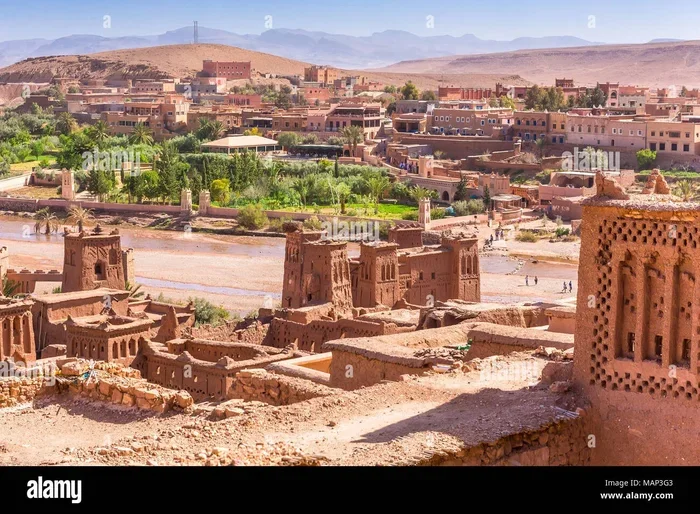
Visual guide about Ait Ben Haddou Kasbah Morocco
Image source: c8.alamy.com
Days 1-2: Tangier to Chefchaouen and the Rif Mountains
Your adventure begins in Tangier, a city that has seduced writers like Paul Bowles and William Burroughs. After exploring the Kasbah, the medina, and perhaps the famous Café Hafa overlooking the sea, you’ll hit the road west toward Chefchaouen.
The drive takes about 2.5 hours, climbing into the Rif Mountains. The landscape transforms from coastal flatlands to cedar forests and terraced farms. Then, suddenly, Chefchaouen appears, a town painted in fifty shades of blue.
Why blue? There are competing theories. Some say it symbolizes the sky and heaven. Others claim it repels mosquitoes. The truth? Nobody really knows, and that’s part of the charm. Spend your afternoon wandering the indigo alleys, photographing doorways draped in bougainvillea, and sipping tea on a rooftop terrace.
Pro tip: Stay overnight in Chefchaouen rather than rushing through. The town is magical at dawn when the alleys are empty and the light is soft.
Days 2-3: Volubilis, Meknes, and Arrival in Fes
Leaving Chefchaouen, you descend toward the Roman ruins of Volubilis. This UNESCO site features stunning mosaics still inlaid in their original floors, depicting everything from Bacchus to bathing dolphins. It’s easy to imagine Roman senators strolling these same pathways 2,000 years ago.
Analogy time. Visiting Volubilis is like opening an archaeological time capsule. You don’t need to imagine the past because the tiles, columns, and archways are still standing right there.
From Volubilis, it’s a short hop to Meknes, often called the “Versailles of Morocco.” Built by Sultan Moulay Ismail in the 17th century, the city features the massive Heri es-Souani granaries and the stunning Bab Mansour gate. Then, in the late afternoon, you continue to Fes, where you’ll spend two nights.
Days 3-4: Exploring the Ancient Soul of Fes
Fes is Morocco’s spiritual and intellectual capital, home to the world’s oldest continuously operating university, Al-Qarawiyyin, founded in 859 AD. To put that in perspective, that’s 117 years before Oxford University existed.
Fes el Bali, the old medina, is a labyrinth of 9,400 narrow alleys. No cars enter. Donkeys still haul goods through lanes barely wide enough for two people. It’s like stepping into a medieval city that never modernized.
Highlights include:
- Chouara Tannery: Where leather has been processed the same way for 1,000 years. Bring mint sprigs to counter the smell.
- Bou Inania Medersa: A 14th-century theological school with jaw-dropping tilework.
- Al-Attarine Madrasa: Smaller, less crowded, and equally stunning.
- Nejjarine Museum: Housed in a beautifully restored fondouk (caravanserai).
Did you know? Fes was once the world’s largest producer of leather, and its tanneries still supply high-end fashion houses in Paris and Milan.
Day 5: The Middle Atlas and the Road to the Sahara
Leaving Fes feels like leaving a warm bath. The city wraps itself around you. But the Sahara awaits, and so you drive south through the Middle Atlas Mountains.
This region is Morocco’s “Little Switzerland,” with cedar forests home to the famous Barbary macaques. These are North Africa’s only primates, and they’re surprisingly friendly, often approaching cars hoping for handouts.
The road climbs through Ifrane, sometimes called “Little Switzerland of Morocco” for its alpine-style architecture and clean streets. Then it descends through the Ziz Valley, a stunning palm-lined gorge that looks like a green ribbon draped across the desert. By evening, you arrive at Merzouga or a similar village at the edge of Erg Chebbi.
Day 6: Sahara Desert Experience
This is the day most travelers dream about. You swap your vehicle for a camel and ride into the dunes. Erg Chebbi towers up to 150 meters high (roughly a 50-story building made of sand). At sunset, the dunes shift from gold to pink to deep purple.
Imagine an ocean frozen mid-wave, except the waves are made of sand and stretch to every horizon. That’s what the Sahara feels like.
You’ll spend the night in a Berber-style desert camp. Yes, there are luxury options with private bathrooms and four-poster beds, but even the standard camps offer a magical experience: drum circles, starlit skies, and tagine dinner under the Milky Way.
Practical tip: Bring a warm layer. Desert nights can drop below 10°C (50°F) even in spring.
Days 7-8: Todra Gorge, Ouarzazate, and Ait Ben Haddou
After sunrise over the dunes and breakfast at camp, you begin the final leg west. The road winds through Todra Gorge, a 400-meter-deep canyon where cliffs rise like cathedral walls on either side. Rock climbers love it. Photographers love it. Even non-climbers find themselves staring upward in awe.
Next comes Ouarzazate, the “Gateway to the Sahara” and home to Atlas Studios, where films like Gladiator, Lawrence of Arabia, and Game of Thrones were shot. You can tour the studios or simply admire the wild roses that bloom in the Dadès Valley nearby.
Then, finally, Ait Ben Haddou appears on the horizon. This UNESCO-listed ksar (fortified village) is a cluster of earthen clay buildings stacked on a hillside along the Ounila River. It’s been a backdrop for over 20 Hollywood films, including The Mummy and Gladiator. Yet, despite the fame, a handful of families still live within its walls.
Walking through Ait Ben Haddou at golden hour is the perfect ending to your 8 day tour from Tangier to Ait Ben Haddou. You’ll climb to the top of the highest tower and look out over the river valley, feeling the weight of centuries beneath your feet.
Practical Planning Tips for Your 8 Day Tour from Tangier to Ait Ben Haddou
Knowing the route is one thing. Actually nailing the logistics is another. Here’s the practical side of things that experienced travelers wish they’d known beforehand.
When to Go: Timing Your Trip Right
Morocco’s seasons matter more than you might think. The country has three climate zones in this itinerary alone: Mediterranean coast, mountain, and desert.
Best months: October, November, March, and April. The weather is mild, crowds are thinner, and prices are lower than peak summer.
Shoulder seasons (December-February): Beautiful but cold in the mountains and freezing at night in the desert.
Summer (June-August): Can hit 45°C (113°F) in the Sahara. Not recommended unless you enjoy heat extremes.
Did you know? Ait Ben Haddou’s clay structures are most photogenic just after the rainy season (October-November) when their surfaces have a fresh reddish glow.
What to Pack: The Essentials
Packing smart makes this trip ten times more enjoyable. Here’s a practical checklist:
- Layers: Mornings can be cold, afternoons warm, nights freezing in the desert.
- Modest clothing: Morocco is Muslim-majority. Cover shoulders and knees, especially in medinas.
- Walking shoes: Medina alleys are uneven, rocky, and slippery when wet.
- Scarf or shawl: Doubles as sun protection, modesty cover, and warmth layer.
- Reusable water bottle: Tap water isn’t safe; bottled water adds up.
- Power adapter: Morocco uses Type C and E plugs (European-style round pins).
- Cash: Many small shops and tips don’t accept cards. ATMs are available in cities.
Group vs. Private Tours: Which Is Better?
Tour operators offer both formats. Here’s how they compare:
Group tours are budget-friendly, typically $800-$1,200 per person, and great for solo travelers wanting built-in company. They usually have 12-16 people per vehicle, fixed schedules, and set hotels.
Private tours cost more, often $1,500-$2,500 per person (or flat rates around $2,800 for two), but offer flexibility. Want to stop for an unplanned photo? Done. Want to swap a hotel for a riad? Easy. Want to spend an extra hour at a tannery? No problem.
If you’re a photographer, a couple, or someone who values spontaneity, private tours are worth every penny. If you’re a solo backpacker watching your budget, group tours still deliver the goods.
Budget Breakdown: What Does This Trip Actually Cost?
Money questions matter, so let’s get specific. The 8 day tour from Tangier to Ait Ben Haddou typically includes transportation, accommodation, breakfast, and a licensed driver-guide. What it usually doesn’t include is flights, lunches, dinners, entry fees, and tips.
Sample Budget Per Person
- Tour package (mid-range): $1,200-$1,800
- Accommodation upgrades: $200-$500 (if not included)
- Meals (lunch and dinner): $15-$30/day = $120-$240 total
- Entry fees: $50-$80 total (Volubilis, museums, kasbahs)
- Camel trek: Often included, otherwise $30-$50
- Tips for guides/drivers: $80-$150 total
- Shopping and souvenirs: Highly variable, but plan $100+
Total realistic budget: $1,800-$2,800 per person for a comfortable mid-range experience, excluding international flights.
How to Save Without Sacrificing
You don’t need to go luxury to enjoy this trip. Smart travelers save by:
- Eating lunch at markets instead of restaurants
- Staying in well-rated 3-star riads instead of 5-star hotels
- Booking tours during shoulder season (October or March)
- Joining group tours but requesting small-group options (max 8 people)
- Bringing snacks from home for long driving days
Cultural Insights: What Every Traveler Should Know
Morocco isn’t a museum. It’s a living country with real people, real customs, and real sensitivities. Understanding a few basics transforms your experience from “tourist” to “welcomed guest.”
Greetings Matter
Moroccans value greetings. A simple “Salam alaikum” (peace be upon you) opens doors. So does asking “Labas?” (how are you?) before diving into business. Don’t rush past this step. The conversation is the relationship.
The Art of Bargaining
In medinas, prices are starting points, not final figures. Polite, smiling negotiation is expected. Start at about 50% of the asking price and meet somewhere in the middle. If you don’t want to buy, just say “La, shukran” (no, thank you) and walk away. No hard feelings.
Photography Etiquette
Always ask before photographing people. A smile and gesture usually do the trick. Some Berber communities, especially in remote villages, prefer not to be photographed at all. Respect this. Ait Ben Haddou itself is fine for photos, but individual residents may decline.
Religious Considerations
During Ramadan, eating, drinking, or smoking in public during daylight hours is considered disrespectful. Many restaurants close during the day, but tourist-friendly ones stay open. Plan accordingly if your trip overlaps with the holy month.
Final Thoughts: Why This Journey Stays With You
An 8 day tour from Tangier to Ait Ben Haddou isn’t just a vacation. It’s a passage through time, terrain, and human warmth. You’ll start in a city that looks toward Europe and end in a fortress that looks back across centuries. Along the way, you’ll share mint tea with strangers who feel like old friends by the second cup.
What makes this route unforgettable is the contrast. The blue of Chefchaoen against the gold of Erg Chebbi. The silence of the Sahara against the chaos of Fes’s medina. The modernity of Tangier against the timelessness of Ait Ben Haddou. Morocco isn’t one thing. It’s a thousand things happening at once, and this tour captures that beautifully.
By day eight, when you stand atop Ait Ben Haddou’s highest tower watching the sunset paint the clay walls amber, you’ll realize something. You didn’t just travel across Morocco. Morocco traveled across you. It left fingerprints on your heart that won’t wash off.
So pack your bags. Charge your camera. Bring an open mind. Your 8 day tour from Tangier to Ait Ben Haddou is waiting to change the way you see the world, one blue alley, one golden dune, one ancient stone at a time.
Frequently Asked Questions
What is the best time of year for an 8 day tour from Tangier to Ait Ben Haddou?
The best months are October, November, March, and April, when temperatures are mild and crowds are manageable. Summer can be brutally hot in the Sahara, while winter nights in the desert drop near freezing. Spring and fall strike the perfect balance for both comfort and photography.
How much does an 8 day tour from Tangier to Ait Ben Haddou typically cost?
Mid-range tours run between $1,200 and $1,800 per person, including transport, accommodation, and breakfast. Adding meals, entry fees, tips, and shopping brings the realistic total to roughly $1,800-$2,800. Private tours cost more but offer flexibility that many travelers find worthwhile.
Is the 8 day tour from Tangier to Ait Ben Haddou suitable for families with children?
Yes, this route works well for families with kids over 8 or so. The longest driving days are 4-5 hours, and the camel trek, desert camp, and kasbah explorations thrill most children. Younger kids may struggle with the early mornings and bumpy roads in some sections.
Do I need a visa for Morocco if I’m starting this tour in Tangier?
Most Western passport holders (US, EU, UK, Canada, Australia) can enter Morocco visa-free for up to 90 days. Just ensure your passport is valid for at least six months beyond your travel dates. Cruise passengers arriving at Tangier port follow the same entry rules.
What should I wear on an 8 day tour from Tangier to Ait Ben Haddou?
Pack modest, breathable clothing that covers shoulders and knees, especially in medinas and religious sites. Layers are essential because mornings and desert nights get cold, while afternoons stay hot. Comfortable walking sandals plus closed-toe shoes for cobblestone medinas are ideal.
Can I customize the 8 day tour from Tangier to Ait Ben Haddou itinerary?
Absolutely. Most Moroccan tour operators offer customizable private tours where you can add stops like Essaouira, swap hotels for specific riads, or extend your stay in favorite cities. Group tours are more fixed, but private tours give you complete control over pacing and destinations.