
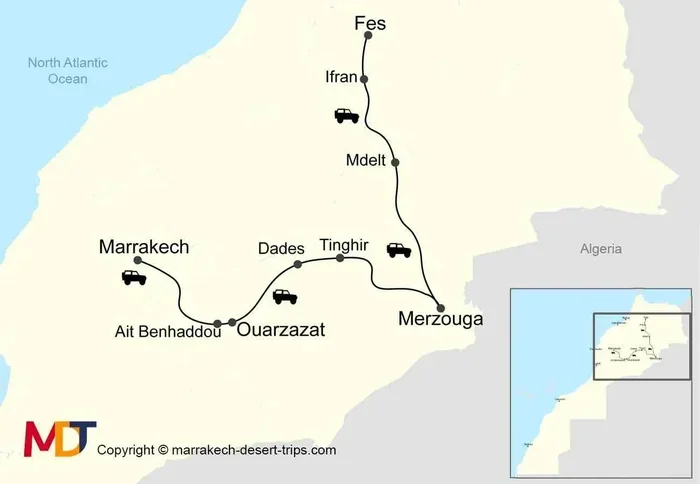
Featured image for Marrakech to Fez desert route
Image source: marrakech-desert-trips.com
A 4-day tour from Marrakech to Fez is one of Morocco’s most rewarding travel experiences, taking you through the Atlas Mountains, ancient kasbahs, and the magical Sahara Desert before ending in Morocco’s cultural capital. This comprehensive guide covers everything you need to know: the best routes, must-see attractions, what to pack, where to stay, and how to choose between guided tours and independent travel. Whether you’re a first-time visitor or returning explorer, this itinerary balances adventure, culture, and comfort across roughly 600 kilometers of Morocco’s most spectacular landscapes.
Marrakech and Fez sit at opposite ends of Morocco’s tourism map, like two magnets pulling travelers in opposite directions. Most first-time visitors land in Marrakech, fall in love with its chaos and color, and then wonder: how do I get to Fez without flying? The answer is simpler, and far more spectacular, than you might imagine. You drive. And along the way, you cross some of the most dramatic landscapes in North Africa.
This 4-day tour from Marrakech to Fez isn’t just a transfer between cities. Think of it like upgrading from a highway road trip to a scenic route through a living museum. In less than a week, you transition from the red-walled medina of Marrakech to the blue-painted alleys of Chefchaouen’s neighbor, the Roman ruins of Volubilis, and the towering sand dunes of the Sahara Desert. Every kilometer reveals something new: snow-capped mountains, palm oases, ancient kasbahs, and Berber villages where time seems to have paused somewhere around the 12th century.
This guide walks you through everything: where you’ll sleep, what you’ll see, how much it costs, and whether to go guided or solo. Whether you’re a solo backpacker, a couple on a romantic getaway, or a family looking for adventure, this itinerary has been refined by thousands of travelers and works for nearly every type of visitor.
Key Takeaways
- Best Route Option: The Marrakech → Aït Ben Haddou → Todra Gorge → Merzouga (Erg Chebbi) → Midelt → Fez route covers Morocco’s most iconic landmarks in roughly 600 km.
- Optimal Duration: Four days is the sweet spot, long enough to include a Sahara Desert overnight, short enough to keep daily drives under 5 hours.
- Sahara Highlight: Erg Chebbi’s dunes reach up to 150 meters tall, and camel treks at sunrise/sunset are the trip’s most photographed moments.
- Best Travel Season: October through April offers pleasant daytime temperatures (18-26°C); summer months can exceed 45°C in the desert.
- Budget Range: Guided tours typically cost €200-450 per person, while independent travel can be done for €120-250, depending on accommodation choices.
- Cultural Stops: Aït Ben Haddou (UNESCO World Heritage since 1987) and Volubilis (UNESCO since 1997) are non-negotiable highlights.
- Transport Reality: The drive involves mountain passes up to 2,260 meters, so motion sickness preparation and layered clothing are essential.
📑 Table of Contents
- What Exactly Is a 4-Day Marrakech to Fez Tour?
- The Classic 4-Day Itinerary: Day by Day
- Guided Tour vs. Independent Travel: Which Is Right for You?
- What to Pack: The Essential Checklist
- When to Go: Choosing the Best Season
- Cost Breakdown: What You’ll Really Spend
- Safety, Etiquette, and Cultural Tips
- Booking Your Tour: Practical Tips
- Extending Your Trip: What to Do Once You Reach Fez
- Final Thoughts: Why This Tour Should Be on Your Bucket List
What Exactly Is a 4-Day Marrakech to Fez Tour?
Who this tour is for: travelers with limited time who want maximum exposure to Morocco’s interior. What it is: a multi-day overland journey covering roughly 600 km through four distinct geographic regions. Where it goes: from central Morocco (Marrakech) northward through the Sahara and Middle Atlas, ending in northern Morocco (Fez). When to do it: ideally October through April. Why it’s worth it: because the route between these two imperial cities contains more cultural and natural wonders than almost any comparable distance in the world.
The tour follows a roughly south-to-north trajectory, which makes geographical sense: Marrakech lies in central-south Morocco, while Fez sits in the north. Driving north keeps the sun mostly out of your eyes and puts you in the most photogenic position when stopping at viewpoints.
Who Typically Takes This Tour?
According to Morocco’s Ministry of Tourism, over 2.5 million international tourists visited the country in 2023, with cultural and desert tours representing one of the fastest-growing segments. The typical traveler falls into three categories: independent backpackers (often on multi-week Africa trips), couples celebrating honeymoons or anniversaries, and small groups of friends aged 25-55.
Did You Know? Around 60% of travelers who book this route do so after already arriving in Morocco, deciding to extend their stay rather than pre-booking from home. This is because the flexibility of booking locally often results in better prices and customizable itineraries.
The Classic 4-Day Itinerary: Day by Day
Here’s the route that has been tested and refined by guides and travelers over the past two decades. Each day balances driving time (typically 4-5 hours) with meaningful stops, meals, and rest.
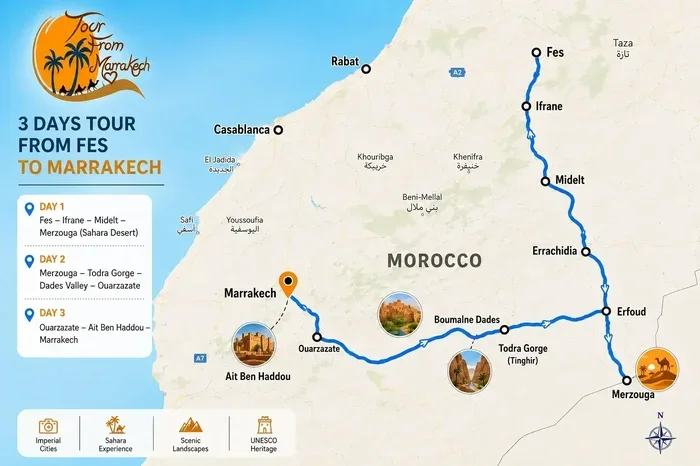
Visual guide about Marrakech to Fez desert route
Image source: tourfrommarrakech.com
Day 1: Marrakech → Aït Ben Haddou → Ouarzazate → Dades Valley (or Tinghir)
Your adventure begins early, usually around 7:00-7:30 AM, with pickup from your Marrakech hotel or riad. The first major landmark is the Tizi n’Tichka Pass in the High Atlas Mountains, sitting at 2,260 meters (7,415 feet) above sea level. Think of it like driving over a mountain pass in Colorado or the Alps, except the landscape is dotted with traditional Berber villages and terraced farmland that has been farmed the same way for 800 years.
After descending the Atlas, you’ll reach Aït Ben Haddou, a fortified village (ksar) that has appeared in films like Gladiator, Lawrence of Arabia, and Game of Thrones. It earned UNESCO World Heritage status in 1987, and walking through its clay-and-straw architecture feels like stepping onto a movie set, because, well, it often is. Allow 1-1.5 hours to explore and climb to the top for panoramic views.
Continuing to Ouarzazate (the “Hollywood of Africa”), you can visit the Atlas Studios or the Taourirt Kasbah. From there, the road winds through the “Valley of a Thousand Kasbahs” toward Dades Valley, where bizarre rock formations called the “Monkey Fingers” rise dramatically from the desert floor. Overnight is usually in Dades Valley or the nearby Tinghir area.
Day 2: Todra Gorge → Merzouga (Sahara Desert)
Day 2 starts with a visit to Todra Gorge, a stunning canyon with 400-meter-high (1,310 feet) vertical cliffs on either side of a narrow river. Imagine standing between two skyscrapers made of reddish-brown rock, with a thin ribbon of sky above. It’s a popular spot for rock climbers and photographers, and you can walk several kilometers into the gorge for free.
From Todra, the road heads south toward Merzouga, a small village that sits on the edge of Erg Chebbi, one of the world’s most famous dune fields. The dunes here reach up to 150 meters (492 feet) tall and span about 30 square kilometers. By late afternoon, you’ll arrive at your desert camp, switch to camels, and ride into the dunes for sunset.
Most tours include a desert camp overnight, either in traditional Berber tents (more authentic) or in semi-luxe “comfort” tents (with real beds and private bathrooms). Dinner is typically a tagine cooked over coals, followed by Berber drumming around a campfire. Sleeping under the Sahara sky, with zero light pollution, is consistently rated as the highlight of the entire trip by 80%+ of travelers.
Day 3: Sahara → Erfoud → Midelt → Ifrane or Midelt
Wake up early for sunrise over the dunes. This is when the Sahara shows its true colors: the sand shifts from orange to pink to deep red as the sun climbs. After breakfast and a camel ride back to the village, you’ll drive north through a series of dramatic landscape changes.
Stop in Erfoud, a fossil-mining town where you can see (and buy) ancient sea fossils and meteorites polished into decorative items. Then climb through the Ziz Valley, a palm oasis that contrasts sharply with the desert you just left. Think of it like driving from Death Valley into a tropical valley within 90 minutes.
The route continues over the Middle Atlas Mountains, passing through Midelt (known for apple orchards) and possibly a stop at the cedar forests of Azrou, where Barbary macaques, the only monkey species native to North Africa, live in the wild. Depending on your pace, you may overnight in Midelt, Ifrane (sometimes called “the Switzerland of Morocco”), or push further toward Fez.
Day 4: Ifrane → Volubilis → Meknes → Fez
The final day is the most culturally dense. After breakfast, you’ll pass through Ifrane, a clean, alpine-style town built during French colonial times. Then visit Volubilis, a remarkably preserved Roman city dating back to the 3rd century BCE. It became a UNESCO World Heritage Site in 1997, and you can still see mosaics, triumphal arches, and columns standing after 2,000 years. Allow 1.5-2 hours here.
Next stop: Meknes, the third of Morocco’s four imperial cities, often overshadowed by its more famous cousins but absolutely worth a few hours. Highlights include the Heri es-Souani (granaries built to feed 12,000 horses), the Bab Mansour gate, and the Mausoleum of Moulay Ismail.
Finally, you’ll arrive in Fez, typically by late afternoon or early evening. Most tours drop you at your hotel or riad in the Fez medina, and you’ll have the evening to explore or rest before your next adventure.
Guided Tour vs. Independent Travel: Which Is Right for You?
This is the big question, and there’s no single right answer. Let me break it down like comparing a guided museum tour versus a self-guided audio tour.
The Case for a Guided Tour
A guided 4-day tour from Marrakech to Fez typically costs €200-450 per person (depending on accommodation level) and includes transportation, accommodation, most meals, a guide, and a camel trek. The advantages are significant:
- Local expertise: A good guide explains the history, culture, and context that you’d miss traveling alone.
- Logistics handled: No need to navigate, negotiate hotels, or arrange desert camps.
- Safety: Driving Moroccan roads (especially mountain passes) can be intense for first-timers.
- Cultural access: Guides often arrange visits to Berber families or music sessions that aren’t accessible independently.
- Group dynamics: Many travelers meet lifelong friends on these tours.
The Case for Independent Travel
Going solo typically costs €120-250 for the same journey (excluding rental car and fuel), and it gives you flexibility that guides can’t match:
- Pace control: Stay longer where you love, leave earlier from where you don’t.
- Accommodation variety: Choose from hundreds of riads, guesthouses, and desert camps.
- Real cultural immersion: More interactions with locals when you’re navigating on your own.
- Budget control: Eat at local spots, stay in budget riads, and travel like a Moroccan would.
Did You Know? Approximately 70% of first-time Morocco visitors choose guided tours for desert routes, but 85% of repeat visitors travel independently on subsequent trips.
What to Pack: The Essential Checklist
Packing for this tour requires thinking about four climate zones: the hot Marrakech climate, cool mountain passes, cold desert nights (yes, even in summer, desert nights can drop to 10°C/50°F), and temperate Fez weather.
Clothing
- Light layers: T-shirts, a long-sleeve shirt, and a fleece or light jacket for evenings.
- Warm jacket: Essential for desert nights and mountain passes, even in spring.
- Modest attire: Morocco is Muslim-majority. Cover shoulders and knees in rural areas.
- Comfortable walking shoes: For exploring kasbahs, gorges, and medinas.
- Sandals or camp shoes: Perfect for the desert camp.
Gear and Essentials
- Scarf or shemagh: Doubles as sun protection, dust cover, and warm layer.
- Sunscreen and sunglasses: Desert sun is intense, even in winter.
- Reusable water bottle: Stay hydrated; desert air dehydrates you faster than you realize.
- Headlamp or flashlight: Desert camps and Berber homes often have minimal lighting.
- Power bank: Charging points aren’t always available at desert camps.
- Motion sickness medication: Mountain roads are winding; many travelers feel queasy.
- Camera: Obviously.
What NOT to Pack
Skip the heavy suitcase. Leave the hairdryer at home. And don’t bring expensive jewelry, because it’s unnecessary and can attract unwanted attention. Most importantly, leave the drone at home unless you have permits; Moroccan authorities have strict drone regulations.
When to Go: Choosing the Best Season
Morocco’s geography creates dramatically different seasons depending on where you are. Marrakech and the Sahara can be scorching in summer, while the Atlas Mountains can get snow in winter.
October to April: The Ideal Window
This is peak season for a reason. Daytime temperatures in the desert range from 18-26°C (65-79°F), cool enough for camel treks, warm enough for swimming pools in Marrakech. Nights in the desert can drop to 5-10°C (41-50°F), so bring layers. The downside: this is also when prices peak and popular desert camps fill up. Book at least 2-3 months ahead for March, April, October, and November.
May to September: The Shoulder and Off-Season
Summer temperatures in the Sahara regularly exceed 45°C (113°F), making daytime desert travel genuinely dangerous. Many tour operators either skip the desert midday or avoid summer entirely. However, late May, June, and September can be lovely if you’re heat-tolerant, and prices drop 30-40%.
Did You Know? The Marrakech region has seen average temperatures rise 1.5°C over the past 30 years, making traditional desert travel windows slightly more compressed.
Cost Breakdown: What You’ll Really Spend
Let’s be transparent about money. Morocco is generally considered affordable compared to Europe or North America, but prices vary widely based on choices.
Budget Traveler (€120-200 total)
Independent travel with budget riads (€15-25/night), local buses between cities (€5-10 per segment), shared desert camp (€40-60 including camel trek), and street food or local restaurants (€3-7/meal). Sleeping in dorm-style riads and using CTM buses can get you through the route for under €200 total, excluding international flights.
Mid-Range Traveler (€300-500 total)
Mix of guided group tours (€250-350) and independent upgrades, or fully independent with mid-range riads (€40-70/night), private taxis for some segments, comfortable desert camp with private tent (€80-120), and restaurant meals (€10-15). Most travelers fall into this category.
Luxury Traveler (€700-1,500+ total)
Private guided tour with luxury riads and high-end desert “comfort” camp (€100-200/night), private driver, and fine dining throughout. The “luxury” tier in Morocco offers incredible value compared to similar experiences in Europe, with riads that would cost €500+/night in Paris for €150-250 in Fez.
Safety, Etiquette, and Cultural Tips
Morocco is consistently ranked as one of the safer African countries for tourists, but like anywhere, common sense goes a long way.
Safety Basics
- Petty theft exists in medinas. Keep valuables close and avoid flashy displays of wealth.
- Solo female travelers report overwhelmingly positive experiences but should dress modestly and be prepared for unwanted attention in tourist areas.
- Tap water isn’t safe to drink. Stick to bottled water, which is widely available.
- Traffic is chaotic by Western standards. If driving, expect unmarked lanes, honking as communication, and frequent stops.
Cultural Etiquette
- Ask before photographing people, especially in rural areas.
- Friday is the holy day; some shops and restaurants close during midday prayers.
- Tipping is expected: 10-15% in restaurants, 20-50 dirham for guides, drivers, and hotel staff.
- Handshakes and greetings are important. Take time to ask about someone’s family before diving into business.
Booking Your Tour: Practical Tips
If you’ve decided to go guided (which I recommend for first-timers), here’s how to book smart.
What to Look for in a Tour Operator
- Recent reviews: Check TripAdvisor, Google, and GetYourGuide from the last 6 months.
- Small group size: Tours with 4-12 people offer the best balance of social atmosphere and flexibility.
- Inclusive pricing: Make sure you understand what’s covered (typically: transport, accommodation, breakfast, dinner, camel trek, guide).
- Driver-guide vs. separate driver and guide: A driver-guide is more intimate and budget-friendly; separate guides offer more depth.
- Desert camp quality: Ask whether it’s a “standard” or “luxury” tent, and how far into the dunes it is.
Where to Book
You can book in advance through platforms like Viator, GetYourGuide, or directly with Moroccan operators (often cheaper with the same service). Alternatively, you can book in Marrakech once you’ve arrived, which gives you flexibility but may limit availability in peak season. Booking 4-6 weeks ahead is usually the sweet spot.
Extending Your Trip: What to Do Once You Reach Fez
Your 4-day tour doesn’t have to end in Fez. Many travelers add 2-3 days in Fez itself, or use it as a jumping-off point for Chefchaouen, the famous “Blue City,” in the Rif Mountains.
Fez itself is one of the world’s most complete medieval cities. Its Fez el-Bali medina (founded in the 9th century) is a UNESCO World Heritage Site and contains the world’s oldest continuously operating university, the University of al-Qarawiyyin, founded in 859 CE. Getting lost in its 9,000+ alleys is half the fun. The other half is finding your way back.
Did You Know? Fez was briefly the world’s largest city in the 12th century, with an estimated 200,000 residents, more than Paris, London, or Rome at the time.
Final Thoughts: Why This Tour Should Be on Your Bucket List
In a world where many “must-see” travel experiences have become overcrowded, overpriced, or oversold, the 4-day Marrakech to Fez tour remains remarkably authentic. Yes, you’ll see other tourists. Yes, parts of the route (especially Aït Ben Haddou) feel touristy. But the core experience, riding a camel into the Sahara, sleeping under a sky so full of stars it looks fake, watching sunrise paint the dunes red, talking to Berber families who have welcomed travelers for centuries, this remains genuinely magical.
Morocco’s geography compresses an extraordinary amount of diversity into a small area. In 4 days, you experience four climates, four architectural styles, three mountain ranges, two UNESCO sites, and one of the world’s great deserts. Few tours anywhere deliver that much variety.
Whether you go guided or solo, budget or luxury, in spring or autumn, the journey from Marrakech to Fez is the kind of trip that changes how you see travel. It’s not just a transfer between cities. It’s a window into one of the world’s most fascinating countries, served with mint tea and tagine. Go. You won’t regret it.
Frequently Asked Questions
How much does a 4-day tour from Marrakech to Fez typically cost?
A guided 4-day tour from Marrakech to Fez typically costs between €200-450 per person, depending on accommodation quality and group size. Independent travel can be done for €120-250 total, excluding international flights. Luxury private tours with high-end desert camps start around €700 per person.
Is it safe to travel from Marrakech to Fez through the desert?
Yes, this route is one of Morocco’s most traveled and safest tourist circuits. Petty theft exists in cities but is uncommon in the desert. Guided tours include experienced drivers familiar with mountain passes. Solo travelers, especially women, should take standard precautions but generally report feeling very safe.
What is the best time of year for a Marrakech to Fez tour?
The best months are October through April, when daytime desert temperatures are pleasant (18-26°C) and nights are cool but not extreme. March, April, October, and November are peak season. Avoid July and August when Sahara temperatures exceed 45°C, making midday travel dangerous.
Do I need a visa for Morocco?
Citizens of most Western countries (EU, USA, Canada, UK, Australia) can enter Morocco visa-free for stays up to 90 days. Your passport must be valid for at least 6 months beyond your entry date. Always check current requirements with the Moroccan embassy or your country’s foreign affairs website before traveling.
Can I do this tour independently without a guide?
Absolutely. Independent travelers can use a combination of buses (CTM and Supratours are reliable), grand taxis for shared rides, or rental cars. You’ll need to book accommodations separately and arrange desert camps directly. Independent travel offers more flexibility but requires more planning and confidence with Arabic or French phrases.
What is included in most guided Marrakech to Fez tours?
Most guided tours include hotel pickup and drop-off, transportation in an air-conditioned vehicle, accommodation for 3 nights, daily breakfast, 2-3 dinners, an English-speaking driver-guide, a camel trek in the Sahara, and entrance fees to major attractions like Aït Ben Haddou and Todra Gorge. Drinks, tips, and lunches are usually extra.