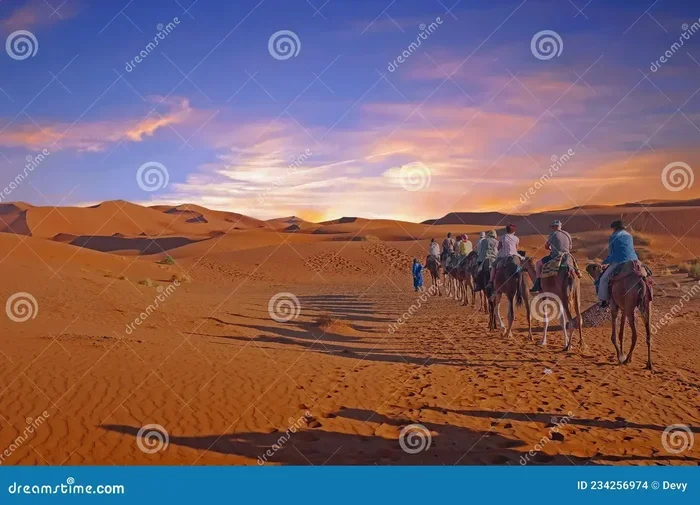
Featured image for Sahara desert camel caravan
Image source: thumbs.dreamstime.com
An 11 day tour from Tangier to the Sahara Desert is the ultimate way to experience Morocco’s diversity in one trip. You’ll travel from the Mediterranean coast through four imperial cities, cross the Atlas Mountains, ride camels into Erg Chebbi, and sleep under starry desert skies. This comprehensive itinerary balances cultural exploration, scenic landscapes, and authentic Berber experiences for travelers who want to see it all.
Picture this: you wake up to the sound of Atlantic waves crashing against Tangier’s old harbor walls, then eleven days later, you’re sitting on a carpet in the middle of the Sahara, watching the sun melt into a sea of orange dunes. That contrast, from the Mediterranean edge to the edge of the world’s largest hot desert, is exactly why an 11 day tour from Tangier to Sahara Desert has become the gold standard for Morocco travelers.
Eleven days is the sweet spot. It’s long enough to actually experience places rather than just photograph them from a bus window. It’s short enough to fit into most people’s vacation calendars without burning through annual leave. And it allows the natural rhythm of Morocco to unfold: bustling medinas, quiet mountain valleys, ancient ruins, and silent desert nights.
This guide walks you through everything you need to know. You’ll learn what the route actually looks like day by day, what makes each stop special, how to choose between group and private tours, what to pack, when to go, and how to avoid the common mistakes that can turn a dream trip into a logistical headache. By the end, you’ll have a clear picture of whether this tour is right for you, and if it is, exactly how to make it happen.
Key Takeaways
- Maximum Variety: An 11 day tour from Tangier to Sahara Desert covers coast, cities, mountains, and dunes in a single, well-paced itinerary.
- Imperial City Loop: The route passes through Fez, Meknes, Volubilis, and Marrakech, giving you Morocco’s cultural heartland.
- Desert Highlights: Camel trekking into Erg Chebbi and an overnight Berber camp are the unforgettable peaks of the journey.
- Seasonal Best Times: October through April offers the most comfortable weather for desert camping and mountain crossings.
- Group vs Private: Small group tours keep costs low, while private tours allow flexible stops and personalized pacing.
- Realistic Pacing: Eleven days prevents the rushed, “highway blur” that shorter Tangier to Sahara tours often suffer.
- Book Early: Premium desert camps and riads fill up 3-6 months ahead during peak season (March-May and September-November).
📑 Table of Contents
What Is an 11 Day Tour from Tangier to Sahara Desert?
An 11 day tour from Tangier to Sahara Desert is a guided overland journey that starts in Tangier on Morocco’s northern Mediterranean coast and ends, most often, in Marrakech, after looping through the country’s interior and reaching the Sahara at Erg Chebbi or Erg Chigaga. Think of it as Morocco’s “greatest hits” route, with enough time to actually enjoy each track.
Most itineraries follow a counter-clockwise loop: Tangier → Chefchaouen → Fez → Merzouga (Sahara) → Todra Gorge → Ait Benhaddou → Marrakech. Some go clockwise. A few end back in Tangier or extend to Essaouira on the coast. But the core idea is the same: cover Morocco’s geographic and cultural range without marathon driving days.
Who Is This Tour For?
This trip is ideal for:
- First-time Morocco visitors who want to see the country’s full range without booking multiple separate trips.
- Slow travel enthusiasts who prefer depth over speed and hate the idea of “one-night stands” in each city.
- Photographers and culture lovers who want time in Fez’s medina, Chefchaouen’s blue lanes, and the dunes at golden hour.
- Couples, families with teens, and solo travelers who want a safe, structured adventure led by a local expert.
It’s less ideal if you’re on a tight budget, hate guided travel, or only want to surf in Taghazout. For those travelers, shorter, more focused tours exist.
Why 11 Days Specifically?
Why not 7 days, and why not 14? Seven-day tours from Tangier to the Sahara are common, but they rush through the imperial cities. Fourteen-day tours add coastal extensions or extra desert time, but they often include filler days. Eleven days hits the balance: two nights in Fez, two nights in the desert, and real time in Marrakech, without exhausting driving stretches. It’s the formula most Moroccan tour operators have refined over decades.
When to Take the Tour: Seasons and Weather
Morocco has three practical travel seasons, and your experience of the desert changes dramatically between them.
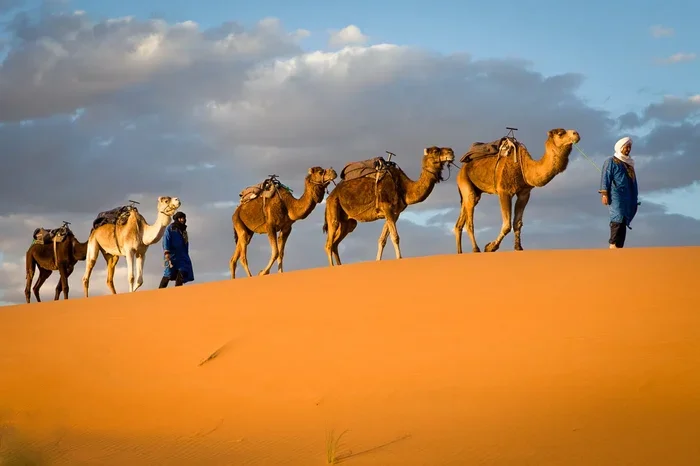
Visual guide about Sahara desert camel caravan
Image source: worldhistory.org
Spring (March to May)
Spring is the most popular time, and for good reason. Daytime temperatures in the Sahara hover around 25-30°C (77-86°F), nights are cool but not cold, and the desert occasionally blooms after winter rains. Did You Know? The Sahara actually does bloom. Roughly every three to five years, rare rainfall triggers a brief carpet of wildflowers in places like Merzouga, transforming the usually arid landscape into a photographer’s dream.
Autumn (September to November)
Autumn rivals spring for ideal conditions, with the bonus of fewer crowds after the European summer holidays end. October is arguably the single best month: warm desert days, crisp Atlas Mountain mornings, and reliable weather across all regions.
Winter (December to February)
Winter tours are possible, especially in the southern dunes around Merzouga, where daytime temperatures can still reach 20°C. However, nights can drop below freezing at higher elevations in the Atlas Mountains, and rare snowfall can occasionally close mountain passes. If you go in winter, pack layers and confirm your route doesn’t include snow-prone passes.
Summer (June to August)
Summer is the season to avoid. Sahara temperatures regularly exceed 45°C (113°F), making midday travel brutal. Mountain towns like Chefchaouen and Ifrane are pleasant, but the desert portion can be genuinely miserable. Operators do run summer tours, but most experienced travelers skip this window.
Where the Tour Goes: Day-by-Day Route Breakdown
While exact itineraries vary by operator, here’s what a typical 11 day Tangier to Sahara Desert tour looks like. Picture it as a 1,800-kilometer loop, roughly the distance from London to Rome, but with infinitely more visual variety.
Days 1-2: Tangier and Chefchaouen
Most tours begin with a pickup from Tangier’s airport, port, or train station. Day one usually covers Tangier’s highlights: the Kasbah, the Café Hafa viewpoint, the American Legation (the first American diplomatic property abroad, by the way), and the lively medina. On day two, you drive into the Rif Mountains to Chefchaouen, the famous “Blue City.”
Chefchaouen is one of those places that looks like a film set. Every wall, every door, every staircase seems painted in a different shade of blue. Analogy time: imagine someone spilled an entire ocean into a small mountain town and the paint just never dried. That’s Chefchaouen. You’ll spend a day wandering its photogenic lanes, hiking to the Spanish Mosque for sunset, and sipping Moroccan mint tea on a rooftop.
Days 3-4: Volubilis and Fez
Day three heads south toward Fez, with a stop at Volubilis, Morocco’s best-preserved Roman ruins. A quick way to appreciate Volubilis: imagine a 2,000-year-old city with mosaics still intact, where you can stand in a Roman bath and see the same olive trees the Romans harvested. The site is a UNESCO World Heritage location and a sharp reminder that Morocco’s history didn’t start with Islam, or even with the Arabs.
Day four is all about Fez, Morocco’s spiritual and intellectual capital. Fez el-Bali, the old medina, is a labyrinth of 9,400 alleys that even Google Maps gives up on. Your guide becomes essential here. You’ll visit the Al-Qarawiyyin University (founded in 859 CE, often cited as the world’s oldest continuously operating university), the Chouara Tanneries, and the Bou Inania Medersa.
Days 5-7: The Middle Atlas, Cedar Forests, and the Sahara
Day five crosses the Middle Atlas through Ifrane, often called “the Switzerland of Morocco” for its alpine-style architecture and clean streets. Nearby Azrou is famous for its Barbary macaques, the only wild monkey population in North Africa. Stop, feed them responsibly (or don’t feed them at all, ideally), and continue through cedar forests where you might spot the rare and endangered.
Day six is the drive into the desert proper. You’ll pass through Errachidia and the Ziz Valley, where a thousand palm trees line a snaking river, before reaching Merzouga on the edge of Erg Chebbi. This is where the camels are waiting.
Day seven is the desert experience. Camel trekking into the dunes takes about 90 minutes. The first time you crest a dune and see nothing but sand in every direction, your brain does a small reset. Did You Know? Erg Chebbi’s tallest dunes reach about 150 meters (492 feet), but they look taller because there’s nothing else around to give your eye a reference point. That’s why the Sahara feels so vast: it’s not just big, it’s empty in a way few landscapes are.
That night, you’ll sleep in a Berber desert camp. Expect tagine dinner, Berber drumming around a fire, and a sky so full of stars it looks fake.
Days 8-9: Todra Gorge and the Road to Ait Benhaddou
After sunrise over the dunes (wake up early, this is non-negotiable), day eight heads west toward Todra Gorge, a 400-meter-deep canyon where cliffs rise vertically on either side of a thin river. It’s a rock climber’s paradise and a great place for a short hike.
Day nine continues via the Dades Valley, often called the “Valley of a Thousand Kasbahs,” and the famous winding road through switchbacks at Ait Bouhlal. The destination is Ait Benhaddou, the UNESCO-listed earthen clay kasbah that has doubled for ancient Egypt, Yemen, and Tibet in films like Gladiator, Lawrence of Arabia, and Game of Thrones.
Days 10-11: Ait Benhaddou, the High Atlas, and Marrakech
Day ten crosses the High Atlas Mountains via the spectacular Tizi-N-Tichka pass at 2,260 meters (7,415 feet). On a clear day, the views stretch for hundreds of kilometers. You’ll reach Marrakech by late afternoon, with time to explore Jemaa el-Fnaa, the famous square that fills with snake charmers, storytellers, food stalls, and musicians as soon as the sun sets.
Day eleven is your Marrakech day: the Saadian Tombs, Bahia Palace, the Majorelle Garden, and any final shopping in the souks. Most tours end with a transfer to the airport.
How to Choose the Right Tour Operator
Not all Tangier to Sahara Desert tours are created equal. The difference between a great trip and a forgettable one often comes down to three factors: guide quality, accommodation standards, and vehicle condition.
Group vs Private Tours
Small group tours (typically 8-16 people) keep costs down, usually between $1,200 and $1,800 per person for 11 days including accommodation, breakfasts, and the desert camp. They’re social, well-organized, and a good choice for solo travelers.
Private tours cost more ($2,400-$4,500 for two people, depending on luxury level), but you control the pace, can detour for impromptu photo stops, and don’t wait on other travelers. For couples and families, private tours often end up being a better value once you calculate the flexibility.
Accommodation Tiers
Morocco offers three practical tiers:
- Standard: Clean 3-star hotels or riads (traditional courtyard guesthouses), shared bathroom in some properties. Affordable, authentic, but basic.
- Comfort: 4-star riads with air conditioning, private bathrooms, rooftop terraces, and often a small pool. This is the sweet spot for most travelers.
- Luxury: 5-star riads, upgraded desert “glamping” tents with private bathrooms and proper beds, and sometimes a private chef. Worth it for honeymoons and special occasions.
What to Look for in a Reputable Operator
Ask these questions before booking:
- Is the company licensed by the Moroccan Ministry of Tourism?
- Do they use official, insured vehicles and licensed guides?
- Can they provide recent, verifiable traveler reviews (TripAdvisor, Google, Trustpilot)?
- Are accommodations confirmed in advance, not “comparable”?
- What’s included and excluded? Fuel, entry fees, lunches, and tips should be clearly listed.
What to Pack for an 11 Day Tour from Tangier to Sahara Desert
Packing smart is half the battle. Morocco’s climate swings wildly: cool coast, hot desert, cold mountains, all in one trip. Here’s a practical list.
Clothing
- Layers, layers, layers. Mornings in the desert are cold, afternoons hot. A fleece or light jacket plus a scarf works year-round.
- Modest, breathable fabrics. Loose long sleeves and pants protect from sun and respect local norms, especially in conservative Fez.
- One warm layer. Even in spring, desert nights and mountain passes can dip to 5-10°C.
- Comfortable walking shoes. Plus sandals for the desert and riad courtyards.
Gear
- Sunglasses and a wide-brimmed hat. Desert sun is relentless.
- Reusable water bottle. Tap water isn’t safe; bottled water is essential.
- Power bank. Long driving days, limited outlets.
- Headlamp. Desert camps and some riads have dim lighting.
- Basic first-aid kit. Plasters, painkillers, rehydration salts.
What to Leave Behind
Skip the drone unless you’ve checked local rules (Morocco restricts drone use heavily). Skip the fancy jewelry. Skip the hairdryer unless you really need one, as voltage differences can be annoying. Did You Know? Morocco uses Type C and Type E plugs, the same as most of continental Europe, so most European chargers work directly. North American travelers will need an adapter.
Common Mistakes to Avoid
Even well-prepared travelers slip up. Here are the most frequent pitfalls on an 11 day tour from Tangier to Sahara Desert, and how to sidestep them.
1. Underestimating Driving Distances
Morocco is smaller than it feels, but mountain roads are slow. A 350-kilometer day that takes four hours on a European highway can take seven hours in Morocco. Build buffer into your expectations.
2. Over-Scheduling Optional Activities
Quad biking, sandboarding, hot-air ballooning, cooking classes: they all sound tempting. Pick one or two, not five. Your energy budget is more limited than you think.
3. Skipping Travel Insurance
Medical care outside major cities can be limited. A comprehensive policy covering evacuation is non-negotiable, especially for desert and mountain segments.
4. Relying Solely on Cards
Smaller shops, market stalls, and many rural restaurants are cash-only. Bring Moroccan dirhams, ideally in small notes, and keep an emergency stash separate from your main wallet.
5. Ignoring Local Etiquette
Ask before photographing people. Don’t point with your finger, use your whole hand. Eat with your right hand when sharing bread. Dress modestly in religious sites. These small courtesies earn genuine warmth from locals.
Conclusion
An 11 day tour from Tangier to Sahara Desert is more than a vacation. It’s a sensory education. You’ll taste tagine slow-cooked over coals, hear the call to prayer echo across five different cities, feel the temperature drop twenty degrees in a single mountain crossing, and watch the Sahara erase the horizon in a way no photo can capture.
The format works because Morocco is genuinely a country of contrasts, and 11 days is just enough time to let those contrasts breathe. You arrive in Tangier with a vague idea of “Arabian nights” and leave from Marrakech understanding that Morocco is Berber, Arabic, French, African, Mediterranean, and Saharan all at once. That shift in perspective is the real souvenir.
If you’re ready to commit, start with research now. Compare two or three reputable operators, decide on your comfort tier, and book three to six months ahead for peak-season travel. Pack the layers, charge the camera, and prepare for the kind of trip you’ll still be talking about a decade later.
Frequently Asked Questions
How much does an 11 day tour from Tangier to Sahara Desert cost?
Small group tours typically cost $1,200-$1,800 per person, while private tours range from $2,400 to $4,500 for two travelers. Prices usually include accommodation, breakfast, transport, and the desert camp, but not lunches, entry fees, or tips.
Is 11 days enough to see Morocco from Tangier to the Sahara?
Yes, 11 days is widely considered the ideal length for a Tangier-to-Sahara loop. It allows two nights in Fez, two nights in the desert region, and real time in Marrakech without rushed driving days.
What is the best time of year for a Sahara tour from Tangier?
Spring (March-May) and autumn (September-November) offer the most comfortable temperatures and clearest skies. October is often considered the single best month for an 11 day Sahara tour.
Do I need a visa for Morocco if I’m visiting the Sahara?
Most Western travelers, including citizens of the US, UK, EU, Canada, and Australia, can enter Morocco visa-free for up to 90 days. Confirm current requirements with your nearest Moroccan consulate before booking.
Is the Sahara camel ride suitable for older travelers or children?
Most camel rides into Erg Chebbi are gentle and suitable for ages 8 and up, as well as older travelers in reasonable health. If a camel ride is a concern, most operators offer 4×4 transfers to the desert camp as an alternative.
What should I wear on an 11 day tour from Tangier to the Sahara Desert?
Pack loose, modest, breathable layers: long sleeves and pants for sun and cultural respect, a warm jacket for desert nights and mountain passes, comfortable walking shoes, and a wide-brimmed hat. Avoid bright, revealing clothing, especially in conservative Fez.