“Morocco does not reveal itself to those in a hurry. But fifteen days? That’s enough time for the kingdom to crack open — and let you inside.”
I’ve traveled to Morocco eleven times. I’ve slept in desert camps, bargained in medinas, and watched the sun rise over the Sahara from the back of a camel. And every single time, without fail, Morocco humbles me.
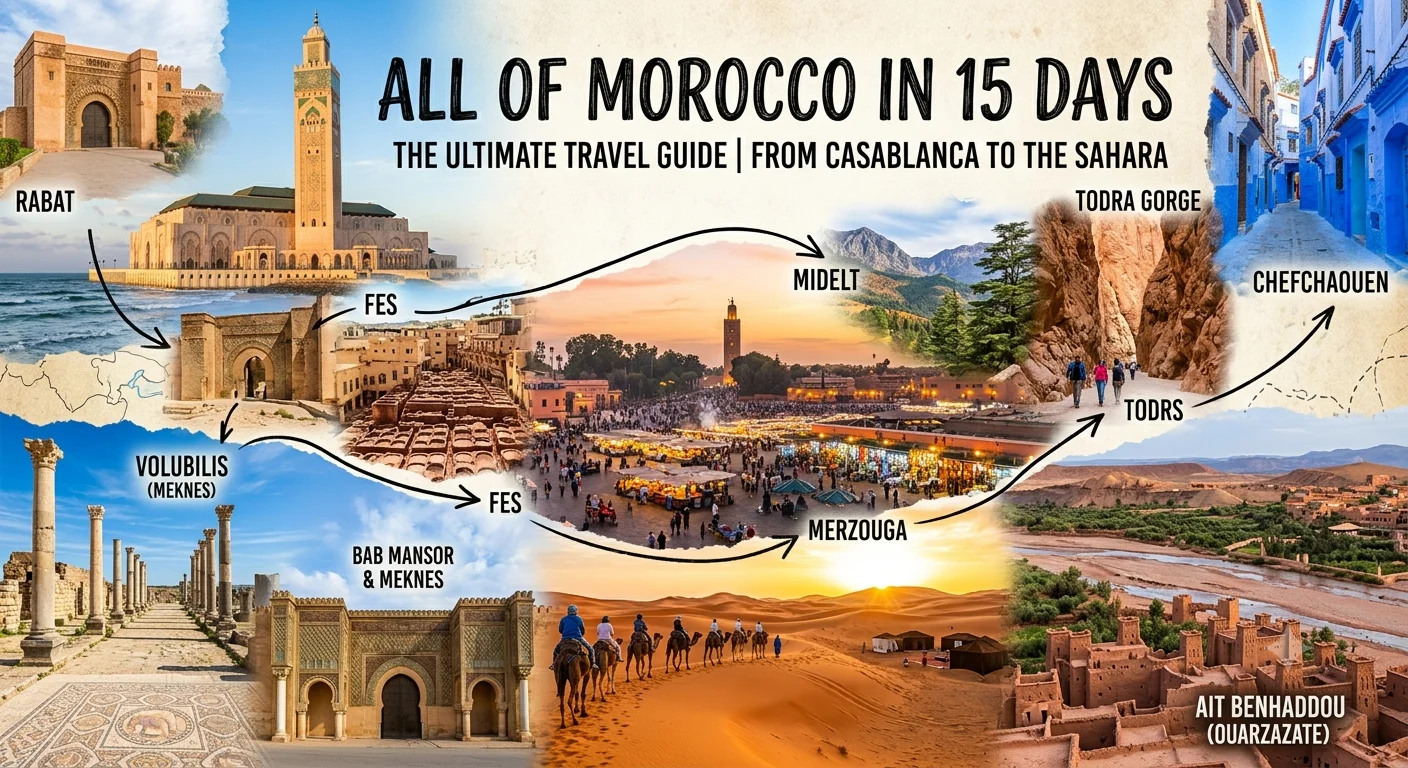
This 15-day itinerary from Casablanca is the one I give to people who ask: “How do I see it all without burning out?” It loops the entire country — four imperial cities, the Rif and Atlas mountain ranges, the Sahara Desert, the Valley of a Thousand Kasbahs, and the Atlantic coast — in a sequence that makes geographic and emotional sense. You build slowly, city by city, toward the drama of the desert, then unwind back through the mountains to the sea.
It is, in my opinion, the single best route through Morocco for first-time visitors. Here’s how to do it right.
Before You Go: Practical Essentials
Best Time to Visit: March–May and September–November are Morocco’s golden windows. Spring brings wildflowers to the Atlas foothills and comfortable desert temperatures (15–25°C). Autumn is crisper, with golden light that makes every medina photograph like a painting. Avoid July–August if you’re heading to the desert — temperatures in Merzouga can exceed 45°C. Ramadan, which shifts annually, is a fascinating but logistically challenging time to travel; some restaurants close during daylight hours.
Visa: Citizens of the US, UK, EU, Canada, and Australia receive a free 90-day visa on arrival. Always check the latest requirements before departure.
Currency: The Moroccan Dirham (MAD). As a rough guide, 10 MAD ≈ 1 USD. ATMs are widely available in cities but scarce in rural areas — always carry cash when venturing into the mountains or desert. Credit cards are accepted at hotels and upscale restaurants but rarely in souks or small eateries.
Getting Around: This itinerary assumes a private driver/guide for the long inter-city legs, which is by far the most practical approach. A good driver is worth his weight in gold — he’ll negotiate parking in labyrinthine medinas, recommend hidden lunch spots, and translate life on the road. Budget approximately $50–80/day for a private driver. Trains connect Casablanca, Rabat, Fes, and Marrakech efficiently, but the desert and mountain routes require private transport.
Accommodation Strategy: Sleep in riads. Always. These traditional courtyard houses, hidden behind anonymous alley doors, are Morocco’s best-kept secret in plain sight. Budget travelers can find clean riads from $25/night; mid-range from $60–120; luxury from $150–400. Book ahead for Fes, Marrakech, and Merzouga, especially during peak season.
Cultural Notes: Morocco is a conservative Muslim country. Dress modestly — covered shoulders and knees, especially in medinas and smaller towns. Remove shoes before entering mosques (non-Muslims cannot enter most active mosques). The call to prayer sounds five times daily; it is one of the most beautiful sounds on earth. Greet people with “Salam Alaikum.” Never rush.
The Route at a Glance
Casablanca → Rabat → Asilah → Chefchaouen → Meknes → Volubilis → Fes
→ Ifrane → Midelt → Merzouga (Sahara) → Todra Gorge → Dades Valley
→ Ouarzazate → Ait Benhaddou → Marrakech → Essaouira → Casablanca
Total driving distance: approximately 2,400 km over 15 days.
Day 1 — Casablanca: The Modern Face of Morocco
Most travelers want to skip Casablanca. Don’t.
Morocco’s largest city and commercial capital is not the atmospheric dreamscape you’ll find in Fes or Marrakech — and that’s precisely its value. It grounds you. It shows you that Morocco is a living, functioning, 21st-century country before the ancient medinas start to feel overwhelming.
Your first afternoon belongs entirely to the Hassan II Mosque, and nothing I write will adequately prepare you for it. Completed in 1993, it is the largest mosque in Africa and the fifth-largest in the world. The minaret rises 210 meters above the Atlantic — on a clear day, you can see it from the plane. Inside (non-Muslims are permitted on guided tours), you’ll walk beneath hand-carved cedar ceilings, across Italian marble floors, and under glass retractable panels that open to reveal the sky. Book a morning tour for the best light. The entry fee is approximately $13.
In the evening, stroll the Corniche — the oceanfront promenade where Casablancans walk, jog, and eat grilled sardines from paper cones. For dinner, the Quartier des Habous (the “new medina,” built by French colonizers in the 1930s as a planned traditional quarter) has excellent traditional restaurants without the tourist markup. Order the couscous aux sept légumes if it’s Friday — that’s the day Moroccan families eat couscous together, and restaurant versions on Fridays are always the best.
Sleep: Stay near the Hassan II Mosque — the early morning light on the mosque’s façade, before the city wakes up, is worth positioning yourself for.
Day 2 — Rabat: The Quiet Imperial Capital
A 45-minute drive north on the A3 highway brings you to Rabat, Morocco’s political capital and the most overlooked of the four imperial cities. Rabat wears its history lightly — there’s no aggressive souk, no flood of tour groups. It is, above all, pleasant.
Start at the Kasbah of the Udayas, a 12th-century fortress perched above the confluence of the Bou Regreg River and the Atlantic. The interior neighborhood — blue-and-white painted lanes, bougainvillea climbing walls, cats sleeping on window ledges — is the medina Morocco promises but sometimes struggles to deliver. The view from the terrace over the river and the old city of Salé is among the finest in the country.
Cross to the city center for the Hassan Tower and the Mausoleum of Mohammed V. The tower — an unfinished 12th-century minaret, columns of pink sandstone standing sentinel around its base — is one of Morocco’s most haunting monuments. The mausoleum beside it, built in 1971, is the resting place of King Mohammed V and King Hassan II, lined with intricate mosaic tilework and always flanked by Royal Guard soldiers in red uniforms and white cloaks. Photography is permitted.
Lunch in Rabat. Then continue north toward the Atlantic coast.
Day 2 (Afternoon) — Asilah: The Gallery Town
Often bypassed, Asilah deserves two hours. This small walled port town on the Atlantic coast has transformed itself into an open-air gallery: every summer, muralists from around the world paint the medina’s white walls, and the results — abstract, political, whimsical — remain year-round. Wander the ramparts at golden hour, look out over the Atlantic, eat a pastry from a street cart. Asilah is Morocco’s exhale before you head into the Rif Mountains.
Drive: Asilah to Chefchaouen takes approximately 2.5 hours through increasingly dramatic mountain scenery. Arrive in time for dinner.
Days 3–4 — Chefchaouen: The Blue City
I have brought twelve people to Chefchaouen. Every single one of them has cried.
Not dramatically — just a quiet, unexpected prickling at the corners of the eyes, usually sometime around the first morning, when you’ve stumbled out of your riad before 7am and found yourself alone in an alley that glows blue and smells of woodsmoke and thyme and distant cedar forests. There’s something about Chefchaouen that disarms people entirely.
Nestled in the Rif Mountains at 600 meters altitude, the city was founded in 1471 as a fortress against Portuguese invaders. The blue paint? The most credible theory is that Jewish refugees who fled the Spanish Inquisition in the 15th century introduced it, the color symbolizing heaven and the divine — and the tradition held. Today, residents repaint their walls roughly twice a year, maintaining the gradient of blues that gives the medina its dreamlike quality: cobalt, cerulean, powder blue, indigo, aquamarine — sometimes all on the same wall.
Day 3: Get lost. Seriously — put your phone away and wander. The medina is compact enough that you can’t get truly lost (though getting pleasantly turned around is part of the experience). Find Plaza Uta el-Hammam, the main square, and have mint tea on a terrace. Visit the 15th-century Kasbah — the tower gives a good overview of the medina layout and the mountains beyond. In the late afternoon, hike 20 minutes up to the Spanish Mosque ruins for a sunset view that has made photographers weep. The light at dusk, when the city below shifts from blue-white to blue-gold, is one of the most extraordinary sights in Morocco.
Day 4: Wake at 6am. I cannot stress this enough. The medina before 8am — when day-trippers from Tangier and Tetouan begin arriving — is a completely different place. The streets belong to the locals: men in djellabas heading to the mosque, women in headscarves carrying bread from the communal oven, cats stretching in shafts of early light. This is the Morocco you came for.
Take a day trip to Akchour Waterfalls (30 minutes by grand taxi), a hike through olive groves and pine forest to a series of emerald pools and cascades. Or simply spend a second day wandering deeper into the medina, looking for the Ras El Ma spring where local women still wash clothes in the cold mountain water.
Shopping note: Chefchaouen is famous for woven wool blankets, leather bags, and hand-painted ceramics. Prices are more relaxed than in Marrakech or Fes. Start negotiations at 40–50% of the asking price and meet somewhere in the middle, always with good humor.
Day 5 — Meknes: The Forgotten Emperor’s City
Driving south from Chefchaouen, the Rif Mountains give way to rolling farmland and then the plateau of the Middle Atlas. Your first stop is Meknes, the least visited of Morocco’s four imperial cities — and perhaps the most underrated.
Meknes was built in the late 17th century by Sultan Moulay Ismail, Morocco’s longest-reigning monarch, who had ambitions to rival Versailles. The results are appropriately grandiose. The Bab Mansour gate — completed in 1732 — is widely considered the finest example of Moroccan imperial architecture: two stories of green-tiled arches and carved stucco framing an opening large enough to march an army through. Moulay Ismail was once said to have inspected the construction by riding through on horseback and killing workers whose mortar wasn’t mixed to his standard. Whether apocryphal or not, the gate is extraordinary.
Also see: the Heri es-Souani granaries and royal stables, built to store grain for the sultan’s enormous standing army (150,000 soldiers, reportedly) and stable 12,000 horses. The vaulted stone underground chambers are cool and cavernous, designed with ingenious ventilation to preserve grain for up to 20 years.
Lunch in Meknes. Then, 30 km north:
Day 5 (Afternoon) — Volubilis: Rome at the Edge of Africa
Volubilis is one of the Roman Empire’s best-preserved cities outside of Italy, and standing amid its triumphal arches, mosaics, and olive presses with the Middle Atlas as a backdrop is one of the strangest, most affecting experiences in Morocco — a reminder that this land has been cosmopolitan for two millennia.
The site covers 40 hectares. The Triumphal Arch of Caracalla, built in 217 AD, still stands to nearly its full height. The floor mosaics — depicting Orpheus charming animals, Bacchus in his chariot, Hercules performing his labors — are remarkably intact, protected by the warm dry air. Visit in the early afternoon (shade is minimal, so bring sun protection) and allow at least 90 minutes.
Evening: Continue to Fes, approximately 60 km east. Arrive in time for dinner in the medina.
Days 6–7 — Fes: The Soul of Morocco
Fes is the oldest and most complex of Morocco’s imperial cities, and two days is genuinely barely enough. The medina, Fes el-Bali, was founded in the 9th century and is the world’s largest living medieval city — a UNESCO World Heritage Site of approximately 9,400 narrow lanes where donkeys are still the primary means of cargo transport and where the 21st century has, in many corners, simply failed to arrive.
You need a licensed guide here. Not a reluctant concession — a genuine recommendation. Without one, Fes el-Bali will eat you alive. With one, it reveals itself as a layered, living document of Islamic civilization.
Day 6 — The Medina in Full:
Start at Chouara Tannery, the city’s ancient leather works and one of Morocco’s most photographed scenes. From viewing terraces above the vat-dyed tanning pits — circles of color like a living painter’s palette, stinking magnificently of pigeon dung (the traditional ammonia source) — you’ll watch workers wade into dye baths in the same way their ancestors did in the 11th century. Leather bags, jackets, and babouches (slip-on slippers) fill the surrounding shops; the quality is high and the prices negotiable.
Nearby: Al-Quaraouiyine University, founded in 859 AD by Fatima al-Fihri and widely recognized as the world’s oldest continuously operating university (the medieval theologians would say “madrasa,” but the historical claim stands). Non-Muslims cannot enter, but you can peer through the carved wooden doors at the courtyard within.
Medersa Bou Inania, a 14th-century theological school open to visitors, is the finest example of Marinid architecture in the country: walls covered floor-to-ceiling in geometric zellige tilework, then carved stucco, then cedar marquetry, the three decorative registers of Moroccan interiors stacked in breathtaking elaboration.
For lunch, a rooftop restaurant overlooking the medina is the standard choice — but better is to follow your guide to wherever the medina’s workers eat. A bowl of harira (the thick lentil-chickpea-tomato soup that is Morocco’s national comfort food) and a msemen (flaky, square flatbread) from a street stall is one of the best meals you’ll eat in the country for under $3.
Day 7 — The New City and Departure Preparations:
The French-built Ville Nouvelle (New City) is worth a morning — the wide boulevards and Art Deco architecture are a jarring and fascinating counterpoint to the medieval medina. Visit the Borj Nord Armory Museum for sweeping city views. In the afternoon, rest — the next few days are long, beautiful drives.
Day 8 — The Road to the Sahara: Through the Middle Atlas
This is the day Morocco opens up.
The drive from Fes to Merzouga (approximately 400 km, 7–8 hours with stops) passes through a Morocco that most tourists never see: the cedar forests of Ifrane, where Barbary macaques sit on roadside walls and the town itself looks improbably like an Alpine Swiss village, all red-roofed chalets and parks; the plateau of Azrou; the high mountain town of Midelt, good for lunch and a wander; and then, gradually, the landscape transforms.
The Atlas foothills flatten into pre-Saharan hammada — a vast, stony desert landscape the color of rust and ochre. Palmeries appear alongside dry riverbeds. The air gets drier. The light gets harder. The shadows get longer. And then, on the horizon as you approach Merzouga, appear the dunes: the great orange-red ergs of the Sahara.
The first sight of the dunes of Erg Chebbi — some reaching 150 meters high — is a moment you will remember for the rest of your life. My advice: don’t try to photograph it. Not yet. Just look.
Day 9 — Merzouga: The Sahara Desert
The camel ride to your desert camp should begin at 4:30pm. Not because the timing is traditional, but because you want to be on the dunes when the sun touches the horizon and the sand turns from gold to copper to the deep red of cooling lava. The temperature will drop 15 degrees in 45 minutes. Stars will appear while it’s still technically dusk.
The overnight desert camp experience ranges from “basic” (a Berber tent, a gas lantern, a thin mattress, and some drumming around a fire) to “glamping” (proper beds, private bathroom, hot shower, three-course dinner, silence). My recommendation is the middle ground: a luxury Berber camp with good food and comfortable beds, but one where you can still step outside at 3am, lie on a dune, and watch the Milky Way arc across a sky undimmed by any light for 200 kilometers in every direction.
The morning camel ride back at sunrise is, if anything, more beautiful than the evening.
Activities around Merzouga:
- 4×4 excursion into the dunes and surrounding desert villages
- Visit to a Gnawa music community — the Gnawa are descendants of sub-Saharan West African slaves brought to Morocco centuries ago, and their trance music and blue robes are haunting and extraordinary
- Fossil shopping in Erfoud — the area around Merzouga sits on an ancient seabed, and trilobites, ammonites, and orthoceras are sold in every shop
Day 10 — Todra Gorge and Dades Valley
The return journey from the desert takes you through two of southern Morocco’s most dramatic landscapes.
Todra Gorge is a canyon carved by the Todra River through the High Atlas, its walls rising 300 meters on either side while the canyon narrows to 10 meters at the base. The light at the bottom is strange and directional — even at noon, the canyon floor is half in shade, half in blinding gold. Climbers come from Europe specifically for Todra’s vertical rock faces. Day visitors can walk the canyon floor in 30 minutes and have lunch at one of the riverside restaurants where trout from the cold mountain river appears on the menu.
Continue west through the Dades Valley — the “Valley of a Thousand Kasbahs” — where ancient fortified earthen towers rise from palmeries and red-rock hillsides in a landscape that looks like the American Southwest filtered through an Islamic architectural lens. The road through the valley winds past villages of pink and ochre pisé (rammed earth) construction, roadside stands selling local honey, and the bizarre Doigts de Singes (Monkey’s Fingers) rock formation near Aït Ouffi, where the eroded hillside forms organic, undulating curves that photographers find irresistible.
Sleep in Ouarzazate.
Day 11 — Ouarzazate and Ait Benhaddou
Ouarzazate — pronounced “war-zah-ZAT” — has a nickname: the Hollywood of Africa. The Atlas Corporation Studios here have produced sets for Lawrence of Arabia, Gladiator, Game of Thrones, The Mummy, Babel, and dozens of other productions; the surrounding landscape of red rock and ksar (fortified village) architecture is simply the most cinematic terrain on earth. You can tour the studios, but honestly: the real thing is better.
Thirty kilometers outside Ouarzazate is Aït Benhaddou, a UNESCO World Heritage Site and the most spectacular ksar in Morocco. A fortified city built of rammed earth and straw along the banks of the Ounila River, it appears to grow organically from the surrounding rock. Climb to the granary at the top for a 360-degree view of desert, mountains, and palmery. Stand there for a while. You have earned this view.
Filming note: the city of Yunkai in Game of Thrones, the arena in Gladiator, the city of Jerusalem in Martin Scorsese’s Kundun — all Aït Benhaddou. The earthen walls glow amber at sunrise and sunset; if you can arrange to arrive in the early morning before day-trippers from Marrakech appear, the place feels genuinely ancient.
Lunch in one of the small restaurants across the dry riverbed from the ksar, then drive to Marrakech.
Days 12–13 — Marrakech: The Red City
The road from Ouarzazate to Marrakech crosses the Tizi n’Tichka pass (2,260 meters) through the High Atlas — the most dramatic mountain road in North Africa, with hairpin turns, roadside Berber villages, and views that seem to encompass the entire country. Allow three hours from Ouarzazate, more if you stop (and you should).
Marrakech, when you arrive, will feel both overwhelming and deeply familiar — this is the Morocco of the postcards and the films and the imagination, fully realized.
Day 12 — The Medina:
The Djemaa el-Fna is the great central square of the medina and one of the world’s most extraordinary public spaces. By day, it’s a modest marketplace — some orange juice stands, a few snake charmers, groups of men playing checkers. By evening, it transforms: food stalls serving steaming tagines, brochettes, snails in spiced broth, and sheep’s head (I recommend the kefta — spiced lamb meatballs in tomato sauce); storytellers in darija (Moroccan Arabic) drawing circles of listeners; musicians playing gnawa music; acrobats; fortune tellers. The square is a UNESCO Intangible Cultural Heritage. Eat there — at least one evening.
The souks north of the square are organized by trade in the medieval tradition: the spice souk, the dyer’s souk, the carpenter’s souk, the leatherworkers, the lamp-makers, the babouche makers, the blacksmiths. Each smells different. Each sounds different. A good guide will thread you through the chaos; a determined independent traveler can also navigate by instinct, which is more fun and more disorienting.
Must-sees: Bahia Palace (a 19th-century vizier’s palace of 160 rooms and an extraordinary central riad garden), the Saadian Tombs (discovered in 1917 after being sealed for two centuries, housing the intricately decorated mausoleum of the Saadian sultans), and the Koutoubia Mosque (Marrakech’s great 12th-century minaret, visible from every corner of the medina, whose proportions influenced the Giralda of Seville and the Hassan Tower of Rabat).
Day 13 — Gardens and Palaces:
Jardin Majorelle, created by French painter Jacques Majorelle beginning in 1924 and restored by Yves Saint Laurent in 1980, is one of the world’s great gardens: cactus, bamboo, and water lily pools surrounding a villa painted in what is now called “Majorelle Blue” — a particular ultramarine that has become the designer’s signature. The Berber Museum within the villa houses an outstanding collection of Amazigh jewelry, textiles, and ceramics. Come at opening time (9am) to avoid the crowds.
For a genuine Marrakech experience, book a traditional hammam (steam bath) session. The Bains de Marrakech or Les Bains d’Orient offer the full treatment — exfoliation with a kessa mitt, a black soap scrub, and a massage — for $30–60. You will emerge feeling entirely reconstituted.
In the evening: a rooftop terrace restaurant in the medina, a glass of fresh jus d’avocat (avocado juice with almonds and orange blossom water — Morocco’s unexpected contribution to smoothie culture), and a final night watching the medina glow in the dark.
Day 14 — Essaouira: The Atlantic Wind
Three hours west of Marrakech, Essaouira stands on a windy promontory above the Atlantic — a white-and-blue walled port city that feels, at first, like Morocco’s answer to Santorini, then reveals itself to be something far stranger and more layered.
Founded by the Portuguese in the 16th century (as Mogador) and rebuilt by French military architect Théodore Cornut in the 18th century, Essaouira has the geometric regularity of a planned city — wide streets, consistent whitewash, fortified ramparts with iron cannons still in their embrasures facing the sea. Jimi Hendrix was famously drawn here in 1969. Orson Welles filmed his Othello here. Today, windsurfers and kitesurfers occupy the beach to the south while the medina fills with artists and craftspeople, musicians and fishermen.
Things to do in Essaouira:
Walk the ramparts at any hour (sunset is spectacular). Explore the harbor, where blue fishing boats unload their catch and the air smells of salt and grilled fish. The seafood here — sardines, sea bass, calamari, sea urchin if the season allows — is the freshest in Morocco; eat at the grill stalls by the port for lunch. Browse the woodworking shops for thuya root inlaid boxes and jewelry — Essaouira is the center of Moroccan marquetry craft. Visit the Skala de la Ville, the seafront fortress, where the Atlantic crashes against the walls and the wind tries to take your hat.
Essaouira is also the most musically alive city in Morocco. Gnawa music drifts from open doorways; buskers occupy every square; and in June, the city hosts the Gnaoua World Music Festival — one of Africa’s great live music events.
Sleep: One night in Essaouira, ideally in a riad with a rooftop terrace. Fall asleep to the sound of the Atlantic and the wind in the ancient medina.
Day 15 — Return to Casablanca
The drive from Essaouira to Casablanca is approximately 3.5 hours north along the Atlantic coast — a gentle, luminous journey past argan forests where goats famously climb trees to eat the argan fruit (a genuinely real phenomenon, though the more photogenic goat trees now sometimes have their goats placed by enterprising herders for tourist tip money — the goats’ expression suggests they have complicated feelings about this arrangement).
Use the drive to decompress. To think about what you’ve seen. To realize, probably, that Morocco has gotten under your skin in a way that only Morocco can — through all the senses simultaneously: the smell of spices in the medina, the cold of the desert at night, the blue of Chefchaouen at dawn, the sound of Gnawa music in an Essaouira alley, the taste of pastilla (pigeon and almond pie dusted with powdered sugar, one of the world’s most improbable and exquisite dishes) in a Fes riad.
You may find yourself at the airport in Casablanca already planning your return.
That’s how Morocco works.
15-Day Itinerary Summary
| Day | Destination | Highlights |
|---|---|---|
| 1 | Casablanca | Hassan II Mosque, Corniche |
| 2 | Rabat + Asilah | Kasbah des Oudayas, Hassan Tower, Mohammed V Mausoleum, Asilah ramparts |
| 3–4 | Chefchaouen | Blue medina, Spanish Mosque viewpoint, Akchour Waterfalls |
| 5 | Meknes + Volubilis | Bab Mansour, Royal Granaries, Roman ruins |
| 6–7 | Fes | Chouara Tannery, Al-Quaraouiyine, Bou Inania Medersa, Medina |
| 8 | Road to Sahara | Ifrane, Midelt, Erg Chebbi arrival |
| 9 | Merzouga (Sahara) | Camel trek, overnight desert camp, stargazing |
| 10 | Todra + Dades | Todra Gorge, Valley of a Thousand Kasbahs |
| 11 | Ouarzazate + Aït Benhaddou | Atlas Studios, UNESCO Ksar, Tizi n’Tichka |
| 12–13 | Marrakech | Djemaa el-Fna, Bahia Palace, Saadian Tombs, Majorelle Garden, Hammam |
| 14 | Essaouira | Ramparts, port, thuya woodwork, Gnawa music |
| 15 | Return to Casablanca | Coastal drive, departure |
10 Things I Wish Someone Had Told Me Before My First Morocco Trip
- The mint tea is always free as a negotiation opener. Once you accept a glass of tea in a shop, the social expectation is that you’ll at least look at their goods. This doesn’t obligate you to buy anything, but it does obligate you to spend five minutes being polite. Accept the tea, enjoy it, and say “la, shokran” (no, thank you) without guilt if you don’t want to purchase.
- Haggling is a performance art, not a conflict. Approach it as theater — offer 40–50% of the asking price, let the vendor express theatrical outrage, meet somewhere in the middle (70% is usually fair on both sides), shake hands, and part as friends. Never get angry. Never make an offer you won’t honor.
- The “student” who offers to show you something for free is never a student. He’s a commission-earning tout for a specific shop. He will be charming, interesting, and not dishonest about who he is if you ask directly. You can follow him, hear his pitch, and still say no.
- Moroccan food is better in homes than in tourist restaurants. If anyone offers to cook for you or invites you for a meal, accept without hesitation. The best couscous I’ve ever eaten was in a farmer’s house outside Ouarzazate. He charged us the equivalent of $4 each for a seven-dish lunch.
- Download maps.me with Morocco offline maps before you go. Google Maps works in cities but is unreliable in the Atlas and desert. Maps.me has the mountain roads and small villages marked in detail.
- Your hotel or riad can arrange everything. Don’t book tours through third parties online. Call your riad in Fes and ask them to recommend a licensed medina guide. Ask your desert camp to organize your camel trek and 4×4. The commissions go to local people, the recommendations are honest, and the logistics are handled.
- Carry small denomination dirhams always. Tips, entrance fees, parking fees, hammam tips, tolls — Morocco runs on small transactions. A 20 MAD note goes a long way. You’ll need coins for public toilet attendants (always a woman, always staffing a very clean toilet, always deserving a dirham or two).
- The best souvenirs are argan oil, saffron from Taliouine, Moroccan leather, hand-knotted Berber rugs, and zellige tiles. The worst are labeled “Made in China” brass trinkets that appear in every souk in the country. Ask before buying whether an item is locally made.
- The weather in the Atlas is unpredictable. I’ve been in Chefchaouen in March in a snowstorm and in T-shirt weather in October. Pack layers regardless of season.
- Give yourself one day of nothing. In a 15-day itinerary this dense, build in one afternoon — ideally in Chefchaouen or Essaouira — with no plan, no sites, no schedule. Wander. Sit in a café. Read. Let the country come to you rather than chasing it. Those are often the hours travelers remember longest.
A Final Word
Morocco is not a country you fully understand in 15 days. You won’t. What you will understand, by the end, is why people return. There is a particular quality to the Moroccan light — especially in the south, in the pre-desert and the desert itself — that changes the way you see color for weeks afterward. There is a particular quality to Moroccan hospitality — diyafa, the ancient obligation of generosity to guests — that recalibrates your sense of what human warmth actually means.
Go. Go with an open itinerary, an open wallet (bring more cash than you think you’ll need), and — above all — an open heart.
Morocco will meet you there.